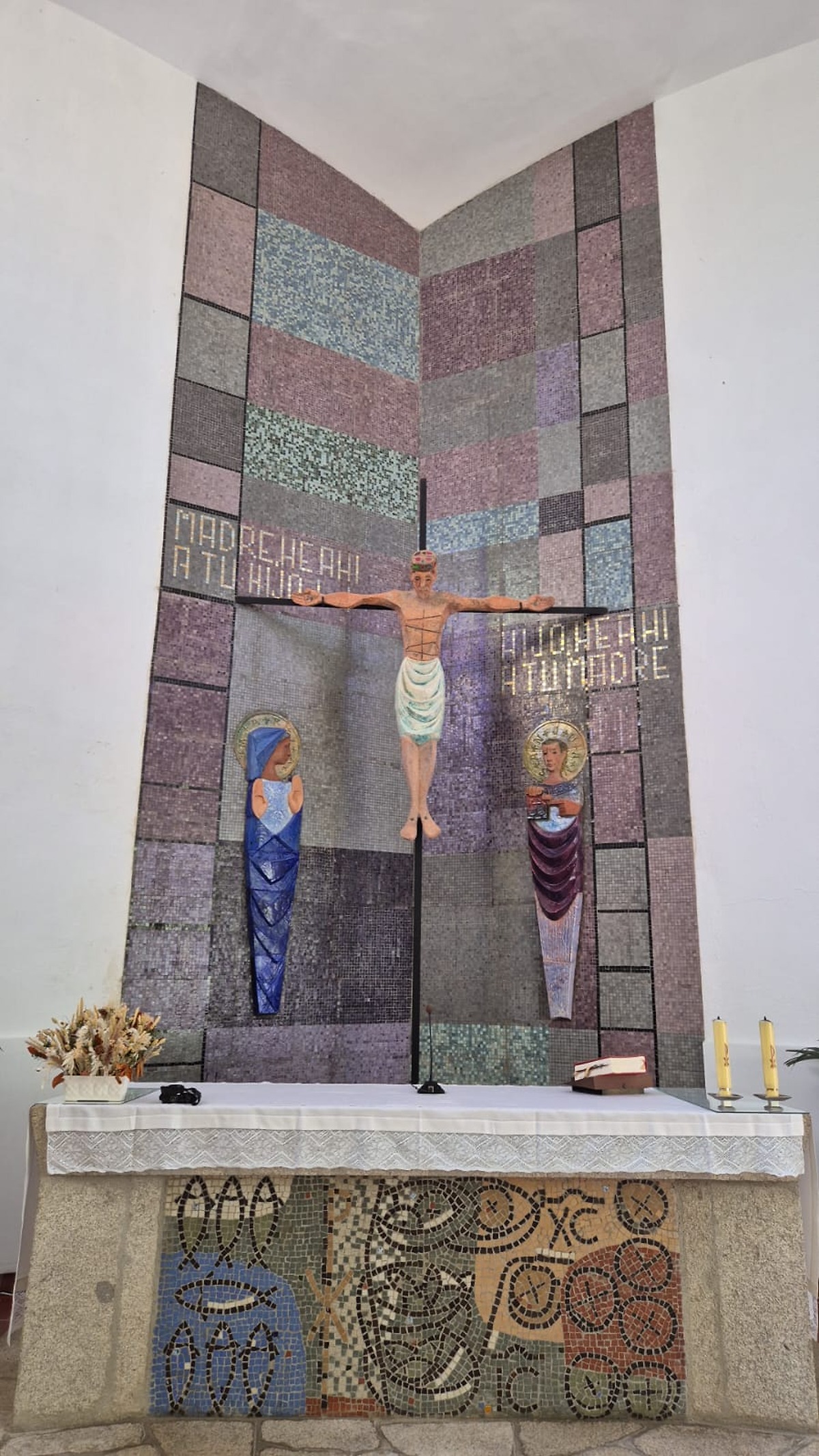
The General Directorate of Cultural and Documentary Heritage, part of the Ministry of Culture, Tourism and Sports, has announced an investment of €40,000 for the restoration of the ceramic wall inside the church of Vegaviana, which represents the Calvary through glazed tile plaques.
This civil movable heritage, managed by the Junta de Extremadura, is located in a settlement established during Spain's Franco regime as part of an agrarian policy aimed at transforming dry areas into irrigated lands. Vegaviana is one of 58 such settlements built in Extremadura between 1950 and 1973, which served as platforms for architectural and artistic experimentation, moving away from historicist architecture towards a modern aesthetic influenced by Spanish avant-garde movements.
The ceramic wall, situated in the apse of the church, occupies the interior angle of the triangular head and is crafted using ceramic techniques. It features various plaques adorned with glazed tiles in shades of black, grey, and violet, forming the backdrop for the figures depicted. The crucified Christ, a round sculpture made from unglazed refractory clay, is notable for its white-glazed loincloth with blue spots and small details around the head. Although it follows a canonical model, the angular forms exhibit cubist influences.
The figure is mounted on an iron cross attached to the wall at the ends of each arm, supported by two bars emerging from the junction of the two masts. The Christ figure is constructed from sharp planes, with angular lines on the torso and pronounced ceramic folds. Flanking the central image are reliefs of the Virgin Mary and Saint John the Baptist, characterised by angular and schematic volumes. These clay pieces are glazed, with inscriptions reading 'Mother, behold your son. Son, behold your mother,' crafted from white tiles.
The sculptural ensemble reflects the early work of José Luis Sánchez Fernández, who was instrumental in the renewal of contemporary sculpture and abstraction in the latter half of the 20th century. The restoration aims to address various conservation issues caused by the passage of time and environmental factors, including deterioration of the ceramic support, irregular darkening of the tiles, and loss of glazing in some areas, alongside superficial dirt accumulation and humidity.
José Luis Sánchez Fernández (1926-2018) was a key Spanish sculptor whose work bridged classicism and primitivism, often incorporating cubist forms and a close relationship with architecture.
Vegaviana, designed by architect José Luis Fernández del Amo, features a layout prioritising open spaces divided by plazas, with clean geometric volumes and minimal decoration. The project aimed to harmonise architecture with the fine arts, inviting prominent artists of the time to contribute murals, stained glass, and stations of the cross, thus modernising the rural environment.