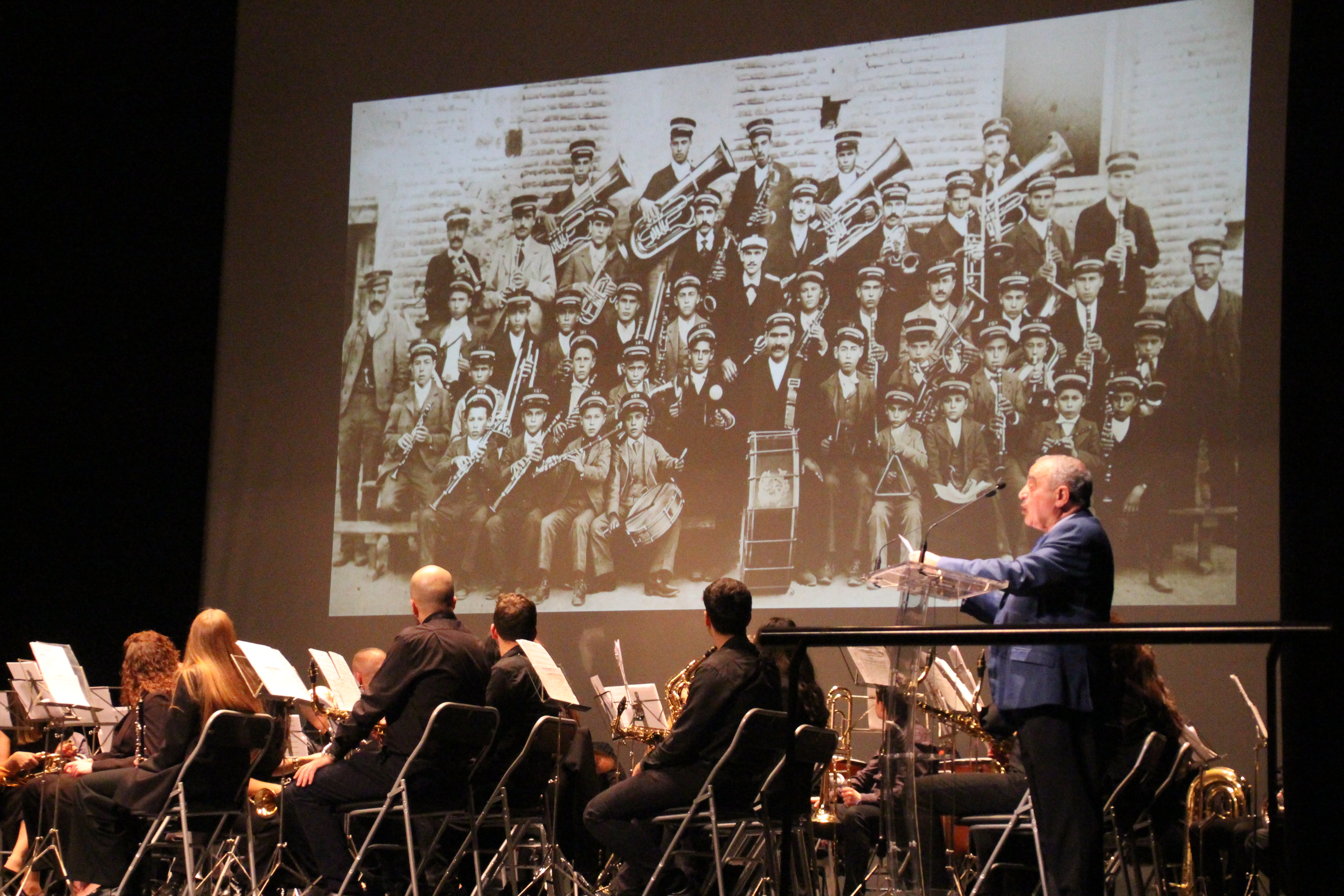
La Banda Municipal de Música de La Solana celebrated the central event of its 125th anniversary on 29 November 2026 at the Tomás Barrera Theatre. The occasion was designed as a musical journey through the ensemble's history, paying tribute not only to its music but also to its musicians.
Significantly, the current director, Ángel Sancho Moraga, who is the great-grandson of the founder, requested a minute of silence to remember all the musicians who have passed away since the band's inception in 1901. The event began with a brief introduction by Sancho, whose ancestor's name is also honoured in the Municipal School of Music and Dance.
Juan Guzmán Sancho, the great-great-grandson of the founder and author of a thesis on his ancestor, followed with remarks. Paulino Sánchez, the official chronicler of the town, then recounted the most significant milestones since the band's founding, supported by images displayed on screen.
The evening concluded with a recital featuring a mosaic of musical styles performed over the past 125 years, including zarzuelas, pasodobles, processional marches, and various adaptations. Notable performances included 'Peñarroya', a piece composed by the founder for the patron saint of La Solana, as well as 'Santiago', conducted by its composer, Francisco Mateos-Aparicio, and the Hymn to La Solana, led by its creator, Emilio Cano.
In comments to the media before the concert, Sancho explained that the performance aimed to be a musical journey through the band's history, encompassing everything from its origins to classical works, film scores, and zarzuela, reflecting the evolution of a civil music band. He candidly acknowledged the ups and downs of the band's journey, noting the challenges faced by rural areas compared to cities, particularly the lack of university campuses. “In the past, not everyone went to study elsewhere, and today, cities with campuses have an advantage that we lack,” he said, adding, “we must learn to live with it.”
Juan Guzmán Sancho expressed his desire to shed light on the figure of his great-great-grandfather, particularly his early years before arriving in La Solana, including his career as a civil salon musician and his work in Madrid's lyrical theatre. “We know details of his early years from chronicles, but not about his time in Madrid, and I believe it is important to provide context,” he stated, calling for greater recognition of his ancestor's contributions.
Paulino Sánchez focused on the band's origins, explaining that it did not start as a municipal entity but as a group of individuals who decided to form a band. They soon sought financial support from the local council, which officially adopted the band as a municipal entity in 1901. He recounted both the triumphs and challenges faced throughout the years, including a notable incident in 1960 when musicians refused to take a specific position in a procession for the Virgin of Peñarroya, resulting in their arrest that night. He also highlighted the difficult years of the 1960s for bands and the inclusion of women in the 1980s.
The final speaker, Antonio Valiente, the councillor for education, emphasised that the band represents more than just its years of existence: “It is a recognition of the work, commitment, and all the components that make it function, from the musicians to the director, along with the families who support them.” He concluded with pride, stating, “It is an honour to have such a prestigious band in La Solana.”