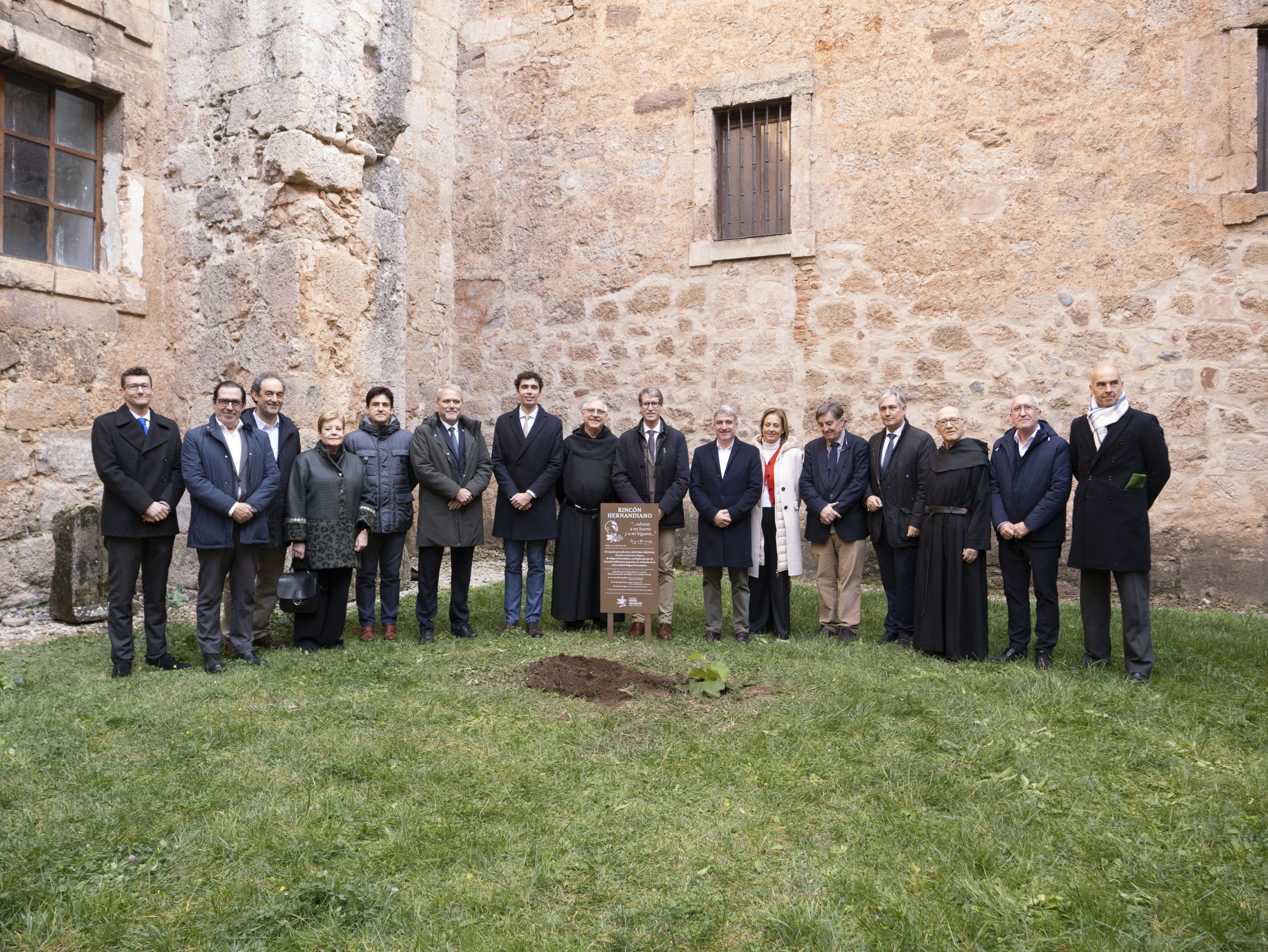
The mayor of Orihuela, Pepe Vegara, along with the councillor for education, Vicente Pina, attended the planting of a cutting from the century-old fig tree of Miguel Hernández on Monday in the Patio de la Luna at the Monastery of Yuso in San Millán de la Cogolla, La Rioja. The event, which also featured the president of the government of La Rioja, Gonzalo Capellán, symbolised the literary partnership between the Orihuela poet and Gonzalo de Berceo, the first known poet in Spanish literature.
Among the attendees were José Luis Pérez Pastor, the regional minister for culture, tourism, sport and youth; Juan José Ruiz, the rector of the Miguel Hernández University; Juan Martínez Tomé, the director of the Orihuela School of Polytechnic Engineering; José Ramón Pérez, the prior of the monastery; and Ismael Maestro, the mayor of San Millán de la Cogolla.
The planting took place as part of the exhibition ‘AutorIA. La Rioja, tierra del español’, currently held at the Monastery of Yuso, which explores the relationship between the Spanish language, literary creation, and artificial intelligence. This location links the tribute to Miguel Hernández with one of the key sites for understanding the origins of Spanish and the figure of Gonzalo de Berceo.
The cutting planted in Yuso comes from the fig tree associated with Miguel Hernández's family life in his home in Orihuela, which is referenced in his poem ‘Elegía’, dedicated to his friend Ramón Sijé. The Miguel Hernández University, through the Orihuela School of Polytechnic Engineering, has developed a cloning process for this tree to preserve its legacy and extend its symbolic value. The arrival of one of these cuttings in La Rioja continues the initiative promoted by the university and the Orihuela city council, establishing a link between the two regions through literature and the memory of their writers.
During his speech, Mayor Pepe Vegara emphasised that “a piece of the heart of Orihuela, a piece of our universal poet Miguel Hernández, will always be connected to La Rioja and this monastery of San Millán de la Cogolla, the cradle of the language,” describing the partnership as “very special, one I will always cherish.”
Meanwhile, President Gonzalo Capellán remarked that “culture serves to unite, just as Spanish unites people from all over the world through a language, a history, and that culture. In these times, it is crucial to remember this.” He added, “Today we formalise a partnership; with this symbolic act, we unite two places and two great poets of Spanish literature. Literature and poetry, without symbols, metaphors, images, and richness, would be nothing. With this cutting from the fig tree, which played such a significant role in Miguel Hernández's life and poetry, we connect a major 20th-century Spanish poet with the first known poet from the 13th century, Gonzalo de Berceo. There are no distances through space, nor through time; today we celebrate 700 years of literary production in Spanish, with a language that projects itself worldwide.”
José Luis Pérez Pastor, the regional minister, described the event as “heartwarming,” stating it serves to “build bridges throughout centuries of history in our Spanish literature.” He quoted Miguel Hernández, saying, “For the human species has given me by inheritance, the family of the child will be the human species.” He expressed that “human beings are united by many things, but one of the strongest bonds is our language, Spanish, which reinforces our ties as we see that history rhymes in various ways.”
José Ramón Pérez, prior of the Augustinian Recollects community of Yuso, noted that “with San Millán, a cultural tradition begins here in this valley of Cárdenas that unites people, opening hearts and arms to welcome all and that unites us. Following this tradition, we welcome you, and it is an honour to unite the first known poet with a poet from a slightly more distant land, but always within this language that unites us, allowing communication, unity, and the ability to walk together while bringing love, hope, joy, and the desire to live into our lives.”
This initiative establishes a connection between two authors from very different eras, united by their contributions to literature in Spanish and the ability of their works to transcend their time. The fig tree of Miguel Hernández will now have a new point of reference in La Rioja, alongside the legacy of Gonzalo de Berceo and within the monastic setting of San Millán de la Cogolla, a UNESCO World Heritage site since 1997. The day concluded with the unveiling of a commemorative plaque marking this symbolic partnership between Miguel Hernández and Gonzalo de Berceo.