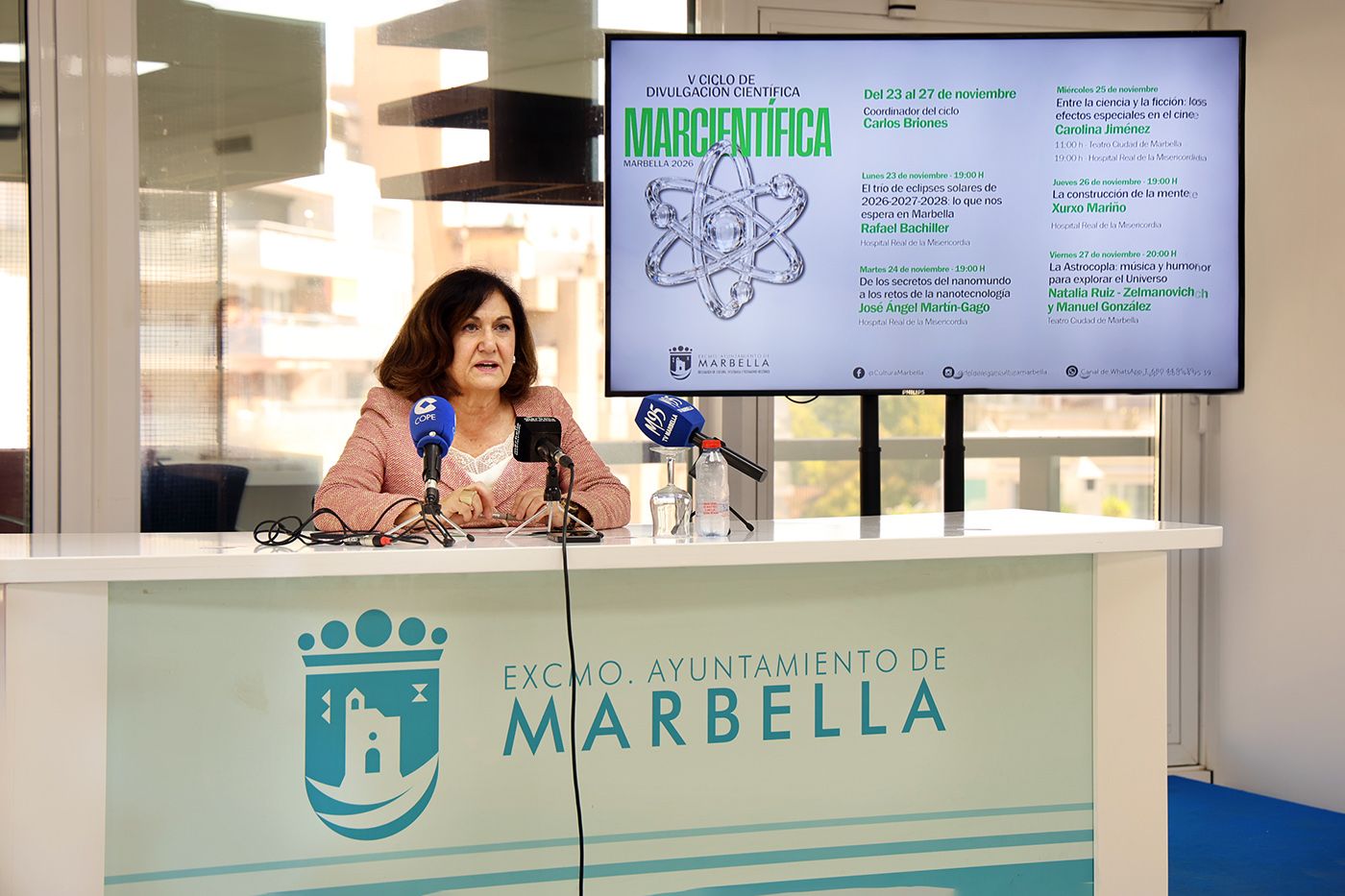
The general director of Culture in Marbella, Carmen Díaz, has unveiled the fifth edition of 'Marcientífica', an outreach initiative organised by the local government aimed at making the latest advancements in science and technology accessible to the public. The event will run from 23 to 27 November and will facilitate a dialogue between scientific knowledge, the humanities, and the arts.
Díaz emphasised the significance of making these subjects available to society, especially at a time when scientific and technological advancements directly impact daily life. She stated, "This initiative aims to feature speakers who not only have impressive research backgrounds but also possess the ability to communicate knowledge effectively to diverse audiences, regardless of their educational background."
The presentations will take place at the Hospital Real de la Misericordia, starting at 19:00 each evening. The cycle will kick off on Monday, 23 November, with a talk by Rafael Bachiller, director of the National Astronomical Observatory and an acclaimed astrophysicist, titled 'The river of solar eclipses of 2026, 2027, and 2028: What awaits us in Marbella'. This presentation will delve into upcoming astronomical phenomena, particularly those visible from Marbella.
On Tuesday, 24 November, José Ángel Martín-Gago, a nanotechnology expert, will discuss how research at the nanoscale can unveil significant cosmic mysteries and open new technological possibilities in his talk, 'From the secrets of the nanoworld to the challenges of nanotechnology'.
Wednesday, 25 November, will feature a double event. In the morning, a session aimed at high school students will be held at the Teatro Ciudad de Marbella at 11:00. In the afternoon, the Hospital Real de la Misericordia will host a conference entitled 'Between science and fiction: special effects in cinema', led by communicator and specialist Carolina Jiménez, who will explore how scientific and technological advancements are integrated into cinematic language, enabling visual effects that extend beyond science fiction.
Thursday, 26 November, will focus on 'The construction of the mind', presented by Xurxo Mariño, a doctor in Biological Sciences from the University of Santiago de Compostela. This session will centre on the development of the human brain, the formation of its connections, and how experience and learning influence its evolution throughout life. Díaz noted that this talk would also address the implications of these processes for medicine and research into neurological diseases.
The cycle will conclude on Friday, 27 November, at the Teatro Ciudad de Marbella with 'La Astrocopla, music and humour to explore the universe', a performance by Manuel González and Natalia Ruiz-Zelmanovich that will combine outreach, music, and humour to wrap up a week dedicated to exploring the links between science and artistic creation. Díaz indicated that invitations for this event will be available at the box office from Thursday afternoon.
Díaz highlighted that one of the distinguishing features of this initiative is its interdisciplinary nature, asserting that "the division between sciences and humanities is an artificial separation, as science, technology, the humanities, and the arts collectively provide a more comprehensive understanding of the world." She added that the local government is committed to expanding scientific outreach activities, believing that knowledge of advancements and discoveries fosters critical thinking and freedom of thought.
'Marcientífica' is coordinated by Carlos Briones, a scientific communicator and researcher at the Spanish National Research Council (CSIC), who leads a group at the Centre for Astrobiology (CAB, CSIC-INTA, associated with NASA's Astrobiology Program) investigating the origin and early evolution of life and the development of biosensors for applications in biotechnology and astrobiology. Díaz noted that Briones, who has also received the Hiperión Poetry Prize and the BBVA Foundation Award for Scientific Communication, embodies the spirit of an initiative that seeks to bridge the gap between scientific knowledge and various artistic and humanistic disciplines.