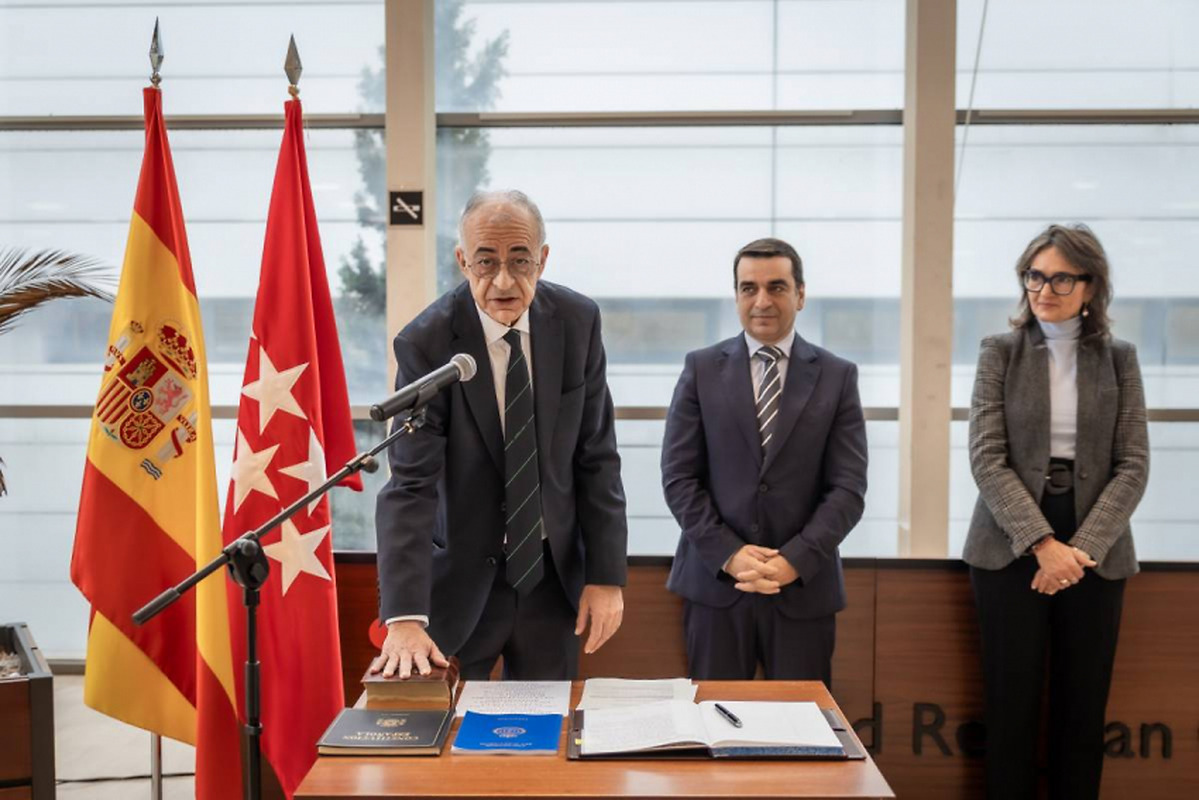
The Faculty of Arts and Humanities at the Universidad Rey Juan Carlos (URJC) has welcomed Miguel Ángel Esparza as its new dean, following an appointment ceremony held in the Sala de las Palmeras at the Móstoles campus. The event took place on 30 October 2023 and was presided over by rector Abraham Duarte.
Esparza, a professor of General Linguistics, was the sole candidate in the recent elections held on 28 October, securing 72.87% of the weighted vote. This appointment extends his leadership at the faculty for an additional six years, following his previous four-year term since the faculty's establishment in 2022.
During his speech, rector Duarte expressed pride in the faculty's achievements, attributing its success to hard work, perseverance, and trust. He reiterated his belief that the humanities should be a priority within the university, citing the decision to relocate the faculty to the Fuenlabrada campus as a means to foster new opportunities for collaboration and growth.
Duarte highlighted the critical role of the humanities in an era dominated by algorithms and robotics, stating, “The university we want to build is one that can integrate scientific and technological advancement with critical reflection, creativity, and a deeper understanding of human experience.”
In his address, Esparza paid tribute to the late German philologist and Romanist Hans-Josef Niederehe, who passed away on 27 October and was awarded an honorary doctorate by the URJC in 2016. He described Niederehe as “a wise, hardworking, humble, and good man.”
Esparza echoed Duarte’s sentiments regarding the importance of humanities in today’s fast-paced technological landscape. He remarked, “The place that corresponds to us, where we are expected, what society demands of us, is to fully engage in the challenge of renewing what Nebrija called the arts of humanity, those that allow us to live in this great community we call a city.”
He also noted that technology companies highly value graduates' ability to ask questions, which requires a broad knowledge base and perspective. However, he acknowledged two significant challenges: teaching young people to appreciate the “quietness that facilitates deep, serious, and enjoyable intellectual work” and advancing joint degrees and programmes that the faculty has been developing.