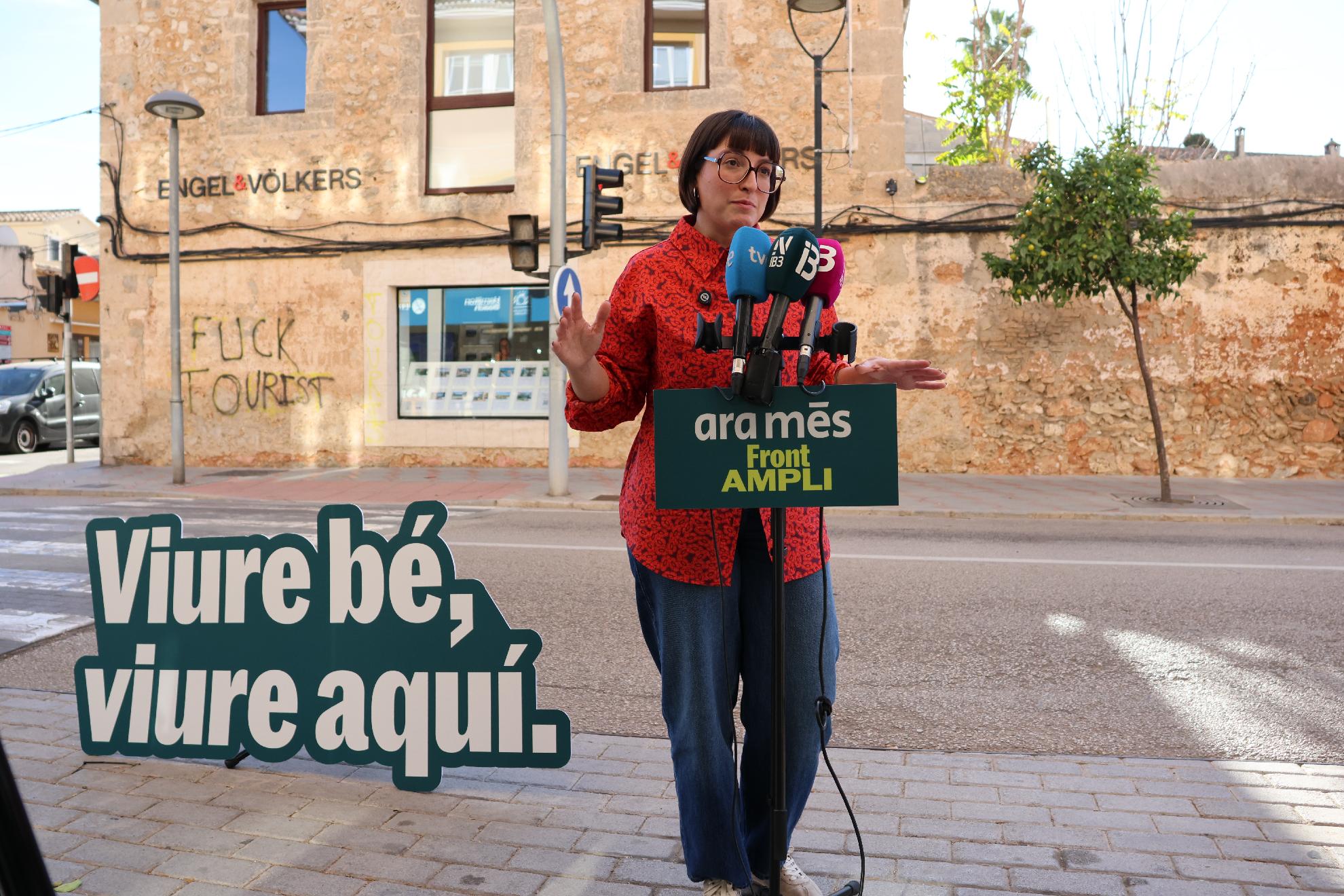
ARAMÉS–Front Ampli has proposed increasing the VAT applicable to tourist accommodation in the Balearic Islands from 10% to 21%. The coalition aims to channel the additional revenue towards public housing, transport improvements, and economic diversification.
Carme Gomila, the coalition's candidate for Congress, has advocated for this measure as a means of ensuring that the wealth generated by tourism contributes to enhancing the living conditions of local residents. She stated, "It cannot be that a family pays 21% VAT on their children's tracksuits while a night in a hotel only incurs 10%. This is a matter of priorities: we want a larger share of tourism profits to benefit the people who live here, who bear the daily consequences of overcrowding."
Gomila highlighted that the Balearic Islands welcomed over 19 million tourists in 2025, with tourism expenditure reaching €23.4 billion. She remarked, "Every year we break records for visitors and tourism spending, yet it is becoming increasingly difficult to afford rent, make ends meet, or get around our own island. We are told that tourism generates significant wealth, but the question is, who truly benefits?"
She clarified that the fiscal proposal is not intended to penalise the tourism sector but rather to redistribute the wealth it generates more effectively. The coalition envisions that the additional resources will allow for increased investment in public housing, improved public transport frequencies and connections, and the promotion of economic sectors such as science, culture, renewable energy, and agriculture.
Gomila stated, "We are not against tourism or anyone. We are in favour of an economy that allows us to live with dignity in our own homes. We cannot continue with a model where profits are at record highs while residents face growing difficulties to live here. We no longer live off tourism; tourism lives off us."
She emphasised that many of the competencies needed to address tourism overcrowding fall under the jurisdiction of the state, including taxation, airport management, and the regulation of certain real estate operations. Therefore, she argued for the need for the Balearic Islands to have greater decision-making power over issues that affect their future.
"Overcrowding is not a natural phenomenon or an inevitable fate. It is the result of political decisions made in Palma and Madrid. And if they are political decisions, they can be changed," Gomila asserted.
On the topic of airport management, ARAMÉS–Front Ampli calls for Congress to approve the airport co-management law proposed by the Balearic Parliament without cuts. The coalition advocates for local institutions to set limits on air activity, establish a cap on flights, halt airport expansions, and restrict night flights and private aviation.
Regarding housing, Gomila reiterated the proposal to prevent speculative and tourist purchases of properties by companies and non-residents through necessary regulatory changes. She stated, "We do not want to turn Mallorca into Europe's second home. We want houses to serve as homes and for local people to be able to develop their life projects without having to leave."
Gomila has been critical of the policies of the Balearic Government led by Marga Prohens and the Spanish government under Pedro Sánchez. She claimed that while the Balearic president acknowledges that the islands have reached their limit, the People's Party (PP) continues to pursue policies that favour tourism growth. She also questioned why the Spanish government is planning to increase airport capacity without granting the islands sufficient decision-making power.
"Prohens says we have reached the limit, yet the PP continues to push for growth. Pedro Sánchez claims to understand the islands' problems, but Aena is still planning for more passengers. Good words are not enough if subsequent decisions go in the opposite direction," she criticised.
Finally, Gomila argued that tourism taxation, airport co-management, and real estate market regulation are part of a broader proposal for changing the economic model. "We want an economy designed for residents, not residents designed for the economy. We want work to allow us to make ends meet, homes to be for living, and for us to continue enjoying our land. It is as simple as being able to live well and live here," she concluded.