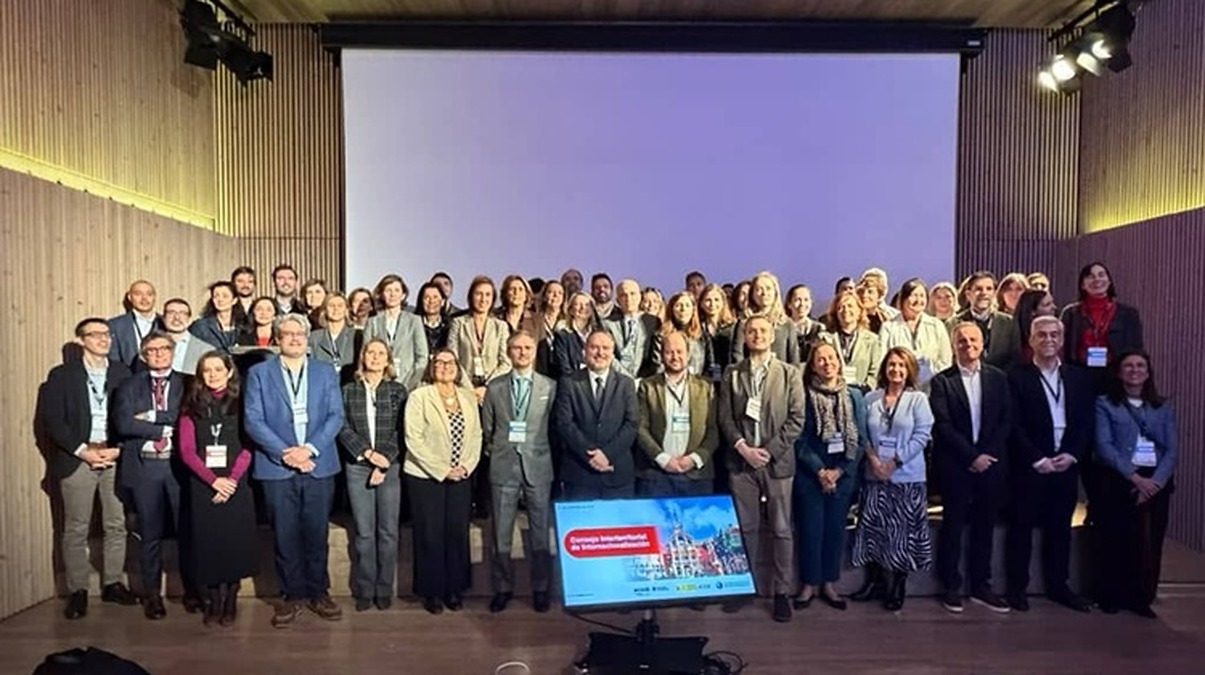
The Catalan government, represented by ACCIÓ (the Department of Business and Labour), presided over the semi-annual meeting of the Interterritorial Council of Internationalisation (CII) on 27 November 2026. This council serves as the primary forum for dialogue and coordination between state and regional administrations and private sector representatives, aimed at enhancing the international competitiveness of the economy.
Catalonia has held the presidency of the council for the second half of the year, focusing on fostering institutional collaboration in promoting international trade and attracting investments. The session was inaugurated by Joan Romero, the executive director of ACCIÓ, and Elisa Carbonell, the CEO of ICEX (the Spanish Institute for Foreign Trade), at the Recinto Modernista de Sant Pau in Barcelona.
The meeting specifically addressed the impact of emerging technologies and artificial intelligence on international business and the activities of promotional agencies. A roundtable discussion was moderated by Guillem Vila, an advisor and director at Oxford Quantum Circuits, featuring Marc Ferré from Deloitte and Pol Valls, the founder of Submer.
Following this, the council held meetings for the Committee for External Promotion (CPE) and the Committee for Investment Attraction (CAI) to discuss strategic issues, share success stories, and define joint working lines. Cristina Serradell, the international business director of ACCIÓ, and Elisa Carbonell opened the session for the CPE.
The agenda also included a panel on the impact of artificial intelligence on European promotional agencies, showcasing experiences from Austria and France, as well as initiatives led by Asturex and Aragón Exterior. Representatives from the State Secretariat for Trade and the Chamber of Commerce of Spain also participated.
Meanwhile, the CAI gathered key investment agencies to exchange experiences, updates, and best practices. Jordi Ortiz, the director of Foreign Investment and Companies at ACCIÓ, and Micaela Arias, the executive director of ICEX-Invest in Spain, inaugurated this session.
The meetings concluded Catalonia's presidency of the CII for the latter half of the year, with a formal handover to Aragón, which will assume the presidency in the first half of 2027. The CII represents a unique cooperation space among autonomous communities, the General State Administration, and the private sector to enhance the international presence of Spanish companies and strengthen foreign investment attraction.
This year, a new Internationalisation Strategy for the Catalan Economy 2026-2030 was approved, led by ACCIÓ, aiming to adapt the Catalan business fabric to the new paradigm of international trade. Key objectives include maintaining current leadership in export volumes, enabling 2,000 new Catalan companies to begin exporting, and reaching 3,500 Catalan companies with subsidiaries abroad.
The strategy also features the public-private programme Cataluña Exporta, designed to assist 2,000 Catalan companies in starting their export activities. Additionally, a new strategy for attracting, capturing, and retaining foreign investment in Catalonia for the period 2026-2030 has been approved, aiming for over €6 billion in investment and the creation and maintenance of 45,000 jobs. This strategy targets the realisation of 600 foreign investment projects with government support by 2030, generating €6 billion in investment, including reinvestments from foreign subsidiaries in the country, and aims to increase the number of foreign subsidiaries in Catalonia to 10,000.