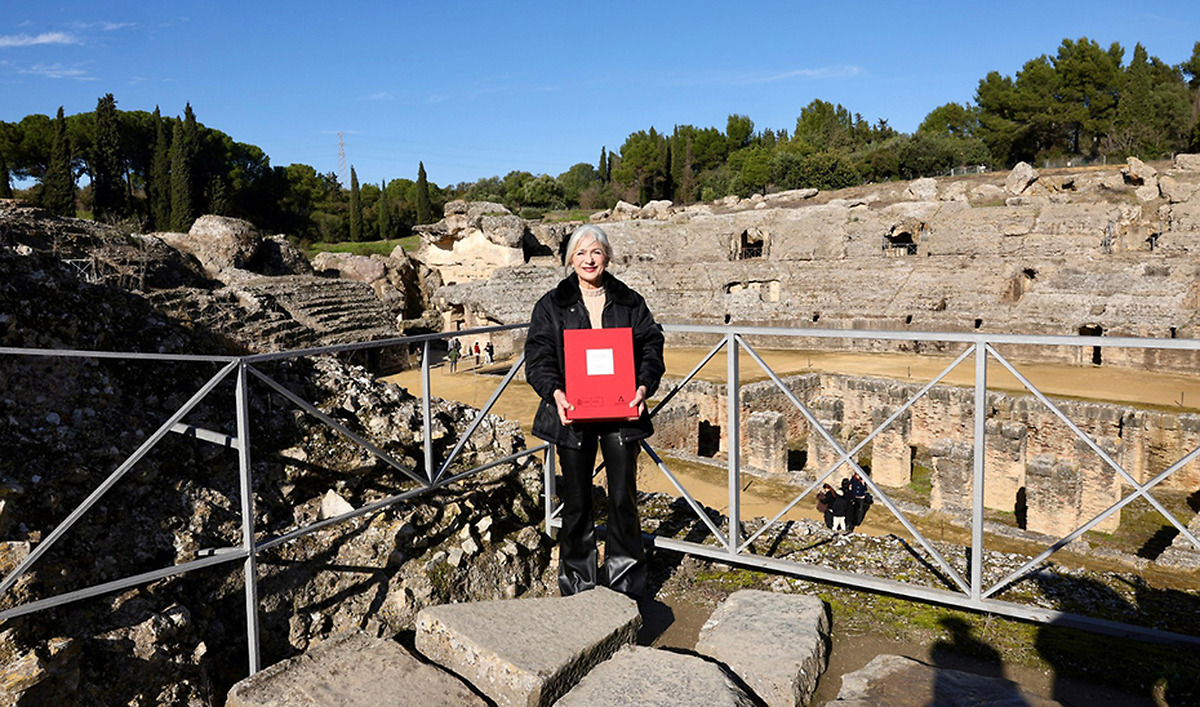
The bid for the City of Itálica to be included on the UNESCO World Heritage List has entered a new phase with its evaluation at the headquarters of the International Council on Monuments and Sites (Icomos) in Paris. This initiative, driven by the Junta de Andalucía and presented by the Ministry of Culture, aims to highlight the exceptional universal values of the ancient Roman city located in the municipality of Santiponce, near Seville.
A Spanish delegation, comprising a representative from the Ministry of Culture and three officials from the Andalusian Ministry of Culture, Heritage and Sport, met with Icomos experts to discuss key aspects of the proposal. Patricia del Pozo, the regional Minister of Culture, highlighted that the candidacy reflects recent advancements in archaeological research, heritage conservation, and dissemination, enjoying unanimous support from scientific, social, and institutional sectors.
Del Pozo noted that the bid has made significant progress ahead of its presentation at the upcoming annual UNESCO World Heritage Committee meeting scheduled for summer 2027. Following this meeting, Icomos is expected to release its report and recommendations by the end of May 2027. The final decision regarding Itálica's inclusion on the World Heritage List will be made by the UNESCO World Heritage Committee during its annual session in July 2027 in Istanbul, Turkey.
In May 2025, the Spanish Historical Heritage Council, representing all autonomous communities and the state, unanimously approved the proposal put forward by the Junta de Andalucía, officially designating Itálica as Spain's candidate for World Heritage status in 2027. The final documentation for the bid was submitted to the UNESCO World Heritage Centre in January 2026, following extensive preparation by scientific and technical teams.
In March 2026, UNESCO confirmed that the bid met the necessary technical and formal requirements, allowing the evaluation process to proceed. A technical evaluation mission took place from 16 to 19 June 2026, during which an international evaluator visited the two components of the bid—the Archaeological Ensemble of Itálica and the Roman Theatre—and held discussions with institutional representatives, researchers, and cultural agents from Santiponce.
Since then, the Ministry of Culture has continued to work closely with Icomos to prepare additional documentation requested, which was submitted in late October 2026. The Paris meeting marks another step in the ongoing evaluation process.
The candidacy, which began in 2018 under the auspices of Civisur, was reformulated in 2024 with the assistance of heritage expert Cipriano Marín and professors of Ancient History from the University of Seville and the Pablo de Olavide University. The revised proposal emphasises Itálica as a prime example of a ceremonial Roman city at the height of the Empire's splendour in the 2nd century AD.
Itálica is noted for its well-preserved urban layout, designed according to the ideals of the time, featuring interconnected ceremonial elements such as grand porticoed avenues, a large imperial cult sanctuary, monumental baths, substantial residences, and an amphitheatre. The grandeur of these structures far exceeded the needs of the local population and their geographical surroundings.
Moreover, Itálica serves as an exceptional testament to the values and beliefs of Roman civilisation at its peak, reflecting a hybrid culture that integrated Mediterranean traditions, combining Roman, Greek, and Egyptian elements in a distinctly Eastern-inspired architectural design. This unique ceremonial aspect positions Itálica within a global context, aligning it with other significant ceremonial and ritual centres from various cultures around the world, marking it as an exceptional archaeological expression of Roman civilization.