On October 4, 2026, José Caro, the provincial delegate of Education, Culture, and Sports in Ciudad Real, praised the XVII Ángel Crespo Poetry Contest held in Alcolea de Calatrava. This initiative, now in its seventeenth edition, plays a crucial role in keeping alive the legacy of one of the prominent figures in Castilian-Manchegan literature while providing a platform for the discovery and recognition of emerging poetic talents.
During the award ceremony, which coincided with the centenary of Ángel Crespo's birth, Caro stated, “The true value of this contest lies not only in its continuity but in what it represents for Alcolea: a way to maintain the connection between this town and one of the great names in 20th-century Castilian-Manchegan literature, while also opening that legacy to new voices and creators.”
Caro emphasized that the contest serves as a means to preserve cultural memory, not merely by remembering Ángel Crespo but by ensuring that, in his name, “new poems continue to emerge.” He reflected on the poet's trajectory as an essayist, critic, and translator, highlighting the ability of culture to bridge authors, territories, and readers.
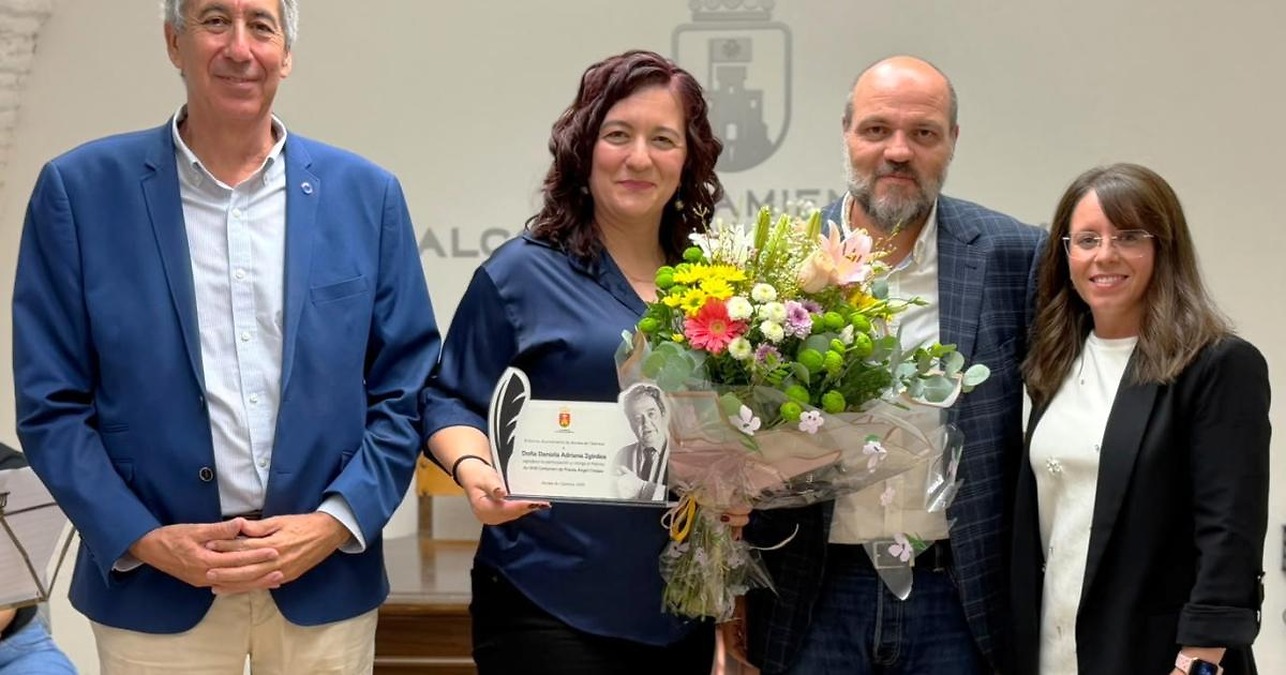
He also congratulated the winner of this edition, Daniela Adriana Zgirdea, for her poem “Donde el vuelo aprende mi nombre,” recognizing her achievement at a significant moment in her poetic career, having recently rekindled her passion for writing after a long hiatus.
Caro pointed out the importance of initiatives like this contest in a society often characterized by immediacy. “Poetry proposes exactly the opposite. It asks us to pause, listen, revisit a word, and discover that a few lines can express something that perhaps would require entire pages to explain,” he remarked.
In this context, Caro highlighted the role of education and culture in promoting reading among younger generations. “From education, we work to ensure that reading and writing are much more than academic skills. We want them to be tools for developing thought, sensitivity, and a personal perspective on the world,” he asserted.
He argued that fostering a reading habit and access to culture also helps form citizens with greater critical capacity and understanding of their environment. “A society that reads, creates, and has access to culture is also a society better equipped to understand and coexist,” he added.
Finally, José Caro acknowledged the efforts of the Alcolea de Calatrava Town Hall, its Popular University, the jury, and all those who contribute to the continuity of this contest, now in its seventeenth year. “Investing in culture from our towns means creating opportunities for creation and participation, while also preserving a memory that belongs to everyone,” he concluded.