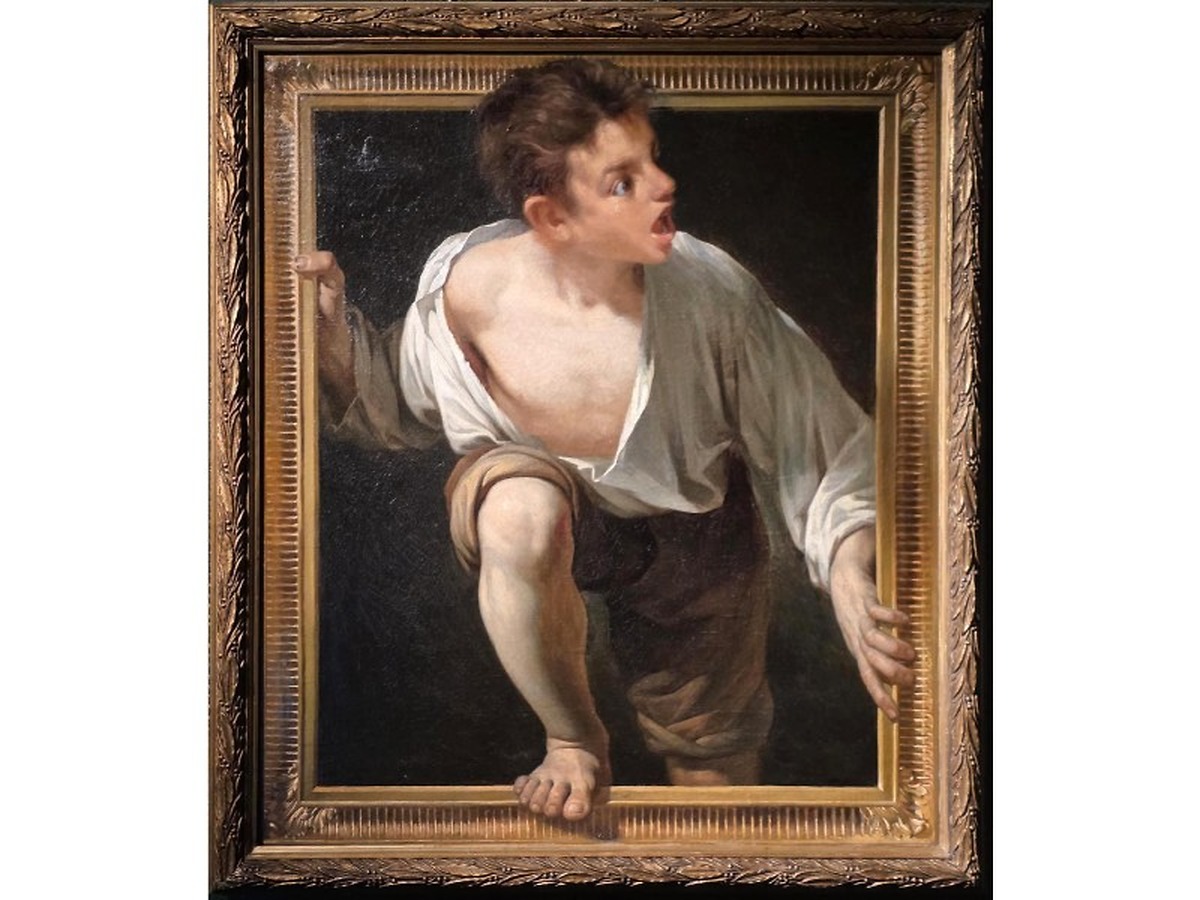
The Catalan government has acquired Fugint de la crítica II, a significant painting by Pere Borrell del Caso, one of the most emblematic works of 19th-century Catalan art. The piece, created in 1876, was purchased for €130,000 and will become part of the National Collection of the Generalitat.
This painting is one of the original versions of the composition Fugint de la crítica, which is among the artist's most renowned creations and a prime example of the trompe-l’œil technique in 19th-century Catalan painting. The artwork depicts a child appearing to physically emerge from the canvas, leaning against the frame of the composition. Borrell del Caso achieves this illusionistic effect by combining a painted frame within the artwork with the actual frame, blurring the boundaries between the pictorial space and that of the viewer.
Fugint de la crítica II is the second known version of this composition, following the first version created in 1874, which is currently part of the collection at the Bank of Spain. Pere Borrell del Caso (1835-1910), born in Puigcerdà and later based in Barcelona, is a prominent figure in Catalan painting from the late 19th century. Educated at the School of Fine Arts in Barcelona, he primarily focused on realistic painting, producing portraits, religious works, landscapes, genre scenes, and still lifes.
Borrell del Caso was particularly noted for his mastery of trompe-l’œil, a technique that creates optical illusions challenging the boundaries between painting and reality. His first version of Fugint de la crítica in 1874 marked a significant success in his career and solidified this pictorial technique within his oeuvre. The artist also had a notable teaching career, founding a private drawing academy in Barcelona in 1868, which became a key centre for artistic training and influenced many generations of Catalan artists.
The acquisition of Fugint de la crítica II aligns with the acquisition policy of the Department of Culture, which, through the National Fund for the Acquisition of Cultural Assets, promotes the inclusion of artistically, historically, and culturally significant works into the National Collection. Acquired artworks are deposited in museums and heritage institutions across the country, aiming to enrich public collections and ensure the preservation and dissemination of cultural heritage. In this instance, the painting is set to be displayed at the Museu Nacional d’Art de Catalunya (MNAC), where it will enhance the representation of 19th-century Catalan painting and highlight one of the most distinctive figures of Catalan realism.