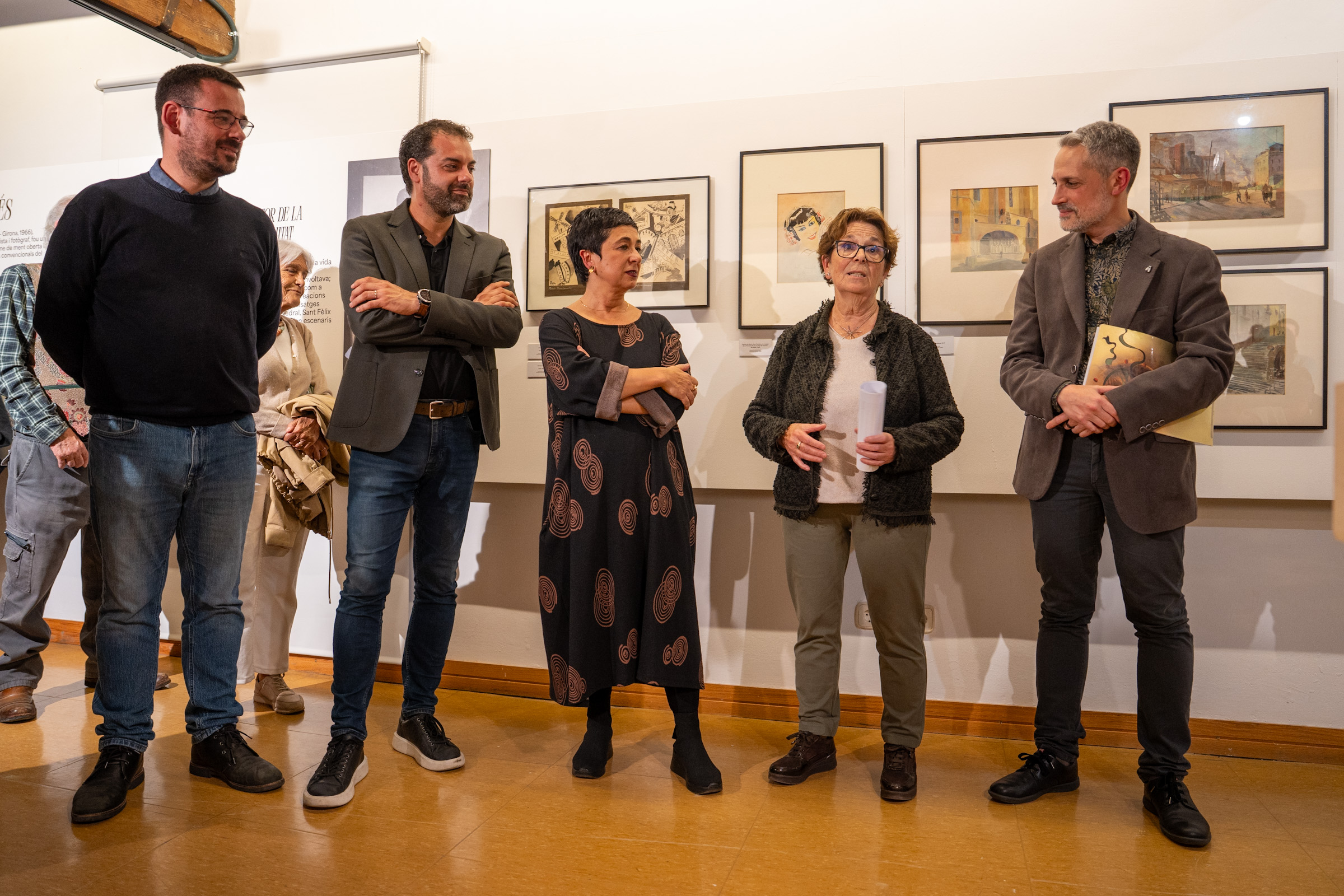
The Museu d’Història de Girona has inaugurated the exhibition 'Remembering Varés', coinciding with the Fires de Sant Narcís festival, to mark the 60th anniversary of the death of Antoni Varés i Martinell (1909-1966). A multifaceted artist, Varés was a filmmaker, painter, graphic designer, publicist, poster artist, and photographer, whose modern and restless spirit was deeply connected to the city of Girona.
The exhibition, located on the fourth floor of the museum, will be open to the public until 10 January 2027, with free admission. It explores Varés's life through personal memories, particularly those of his daughter Albina Varés and others, revealing the intimate stories behind objects, photographs, and artworks that reflect the creative soul of this dreamer.
Lluc Salellas, the mayor of Girona, attended the opening and remarked, 'In an age where everyone carries a camera in their pocket, the significance of historical images becomes even more profound. The records of Antoni Varés are invaluable, offering rare glimpses into the lives of people nearly a century ago. Thanks to his heirs and institutions like the Municipal Archive, these images are preserved, accessible, and shared.'
Quim Ayats Bartrina, deputy mayor and councillor for culture, emphasised Varés's importance in Girona's cultural history, stating, 'With this exhibition, we celebrate his artistic legacy and connection to the city, bringing his work to new audiences to keep it alive in our collective memory.'
A 1992 article by Narcís Jordi-Aragó anticipated Varés's enduring relevance, suggesting that 'we will soon speak of him again, as his periodic resurgence will be a true, persistent return.'
The exhibition comprises six sections, each featuring diverse texts and materials that offer insights into Varés's personal and professional life, highlighting his intrinsic ties to Girona, his home and creative space. The materials on display are sourced from the Museu d’Història's collection and the Varés Archive at the Municipal Archive of Girona, following a donation from his daughter, Albina Varés. She has been the driving force behind this exhibition, ensuring that Varés's legacy is acknowledged.
Complementary activities have been organised around the exhibition, including guided tours led by Albina Varés on 30 October and 18 December at 18:00, as well as a round table discussion featuring David Iglesias, head of the Centre for Research and Dissemination of Image in Girona, historian and cultural manager Pere Parramon, and cultural journalist Eva Vázquez on 15 December at 18:00.
In parallel, the Centre for Research and Dissemination of Image (CRDI) has launched a small exhibition space showcasing Varés's cinematic work and a new online resource featuring all his films. The screenings, located in the entrance hall of the Municipal Archive of Girona, will include three emblematic films: 'Niños' (1953), a fiction film, and two documentaries, 'Desfile militar en Girona y Figueres' (1940) and 'Selección del Noticiario del GEiEG' (1936). This selection aims to highlight different aspects of his cinematic production.
The installation will also feature informational panels about Varés's life and work, alongside a new online resource that categorises his films by genre and provides expanded information, including production photographs and press coverage, as well as a biography and reference bibliography. This initiative aims to promote and facilitate access to his cinematic legacy.
Antoni Varés i Martinell, who studied at the Municipal School of Fine Arts in Girona and later specialised in graphic arts in Paris, began his film career in the early 1930s. Influenced by filmmaker René Clair, he created the short film 'El rapto de Maria Rosa' (1930-1931) in Girona. After returning to Girona following his father's death, he worked as a publicist, graphic designer, and painter, producing over thirty amateur short films and a variety of documentaries and experimental films until his death in 1966 while preparing his most ambitious project, an adaptation of Prudenci Bertrana's novel 'Josafat' (1906).