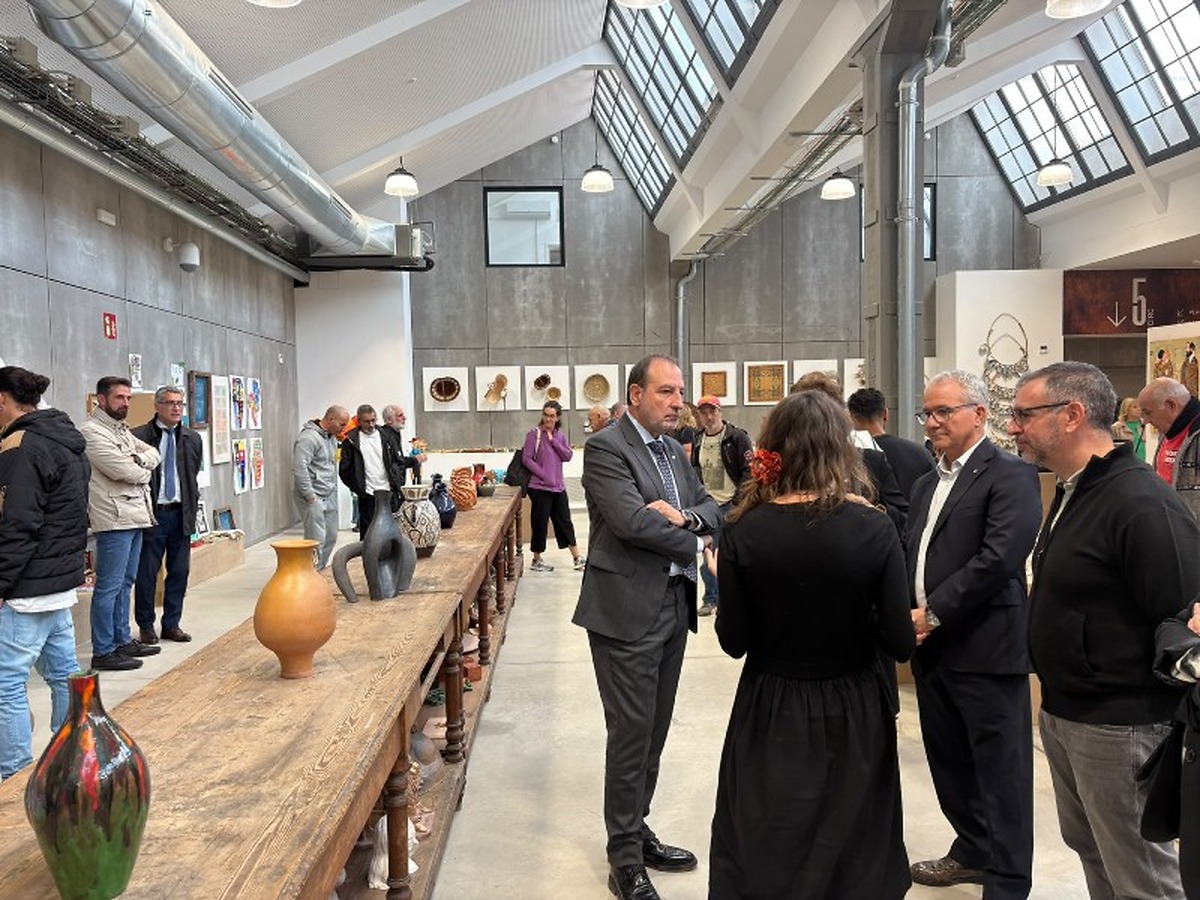
Ramon Espadaler, the Catalan Minister of Justice and Democratic Quality, attended a commemorative event today marking the 40th anniversary of artistic workshops in Catalonia's prisons, held at the Tèxtil Rase - Fábrica de Cultura in Cardedeu. The event celebrated the history of this initiative, recognised the efforts of the professionals involved, and inaugurated the commemorative exhibition L’ametlla amarganta.
Also present were Elena Pérez, the Secretary for Penal Measures and Reintegration, and Domingo Estepa, the Director General of Penitentiary Affairs. Espadaler began his speech by thanking the Cardedeu Town Council and exhibition curator Àngela Martínez for highlighting the experiences of those running the artistic workshops.
He underscored the significant contribution of culture to the rehabilitation and social reintegration processes, stressing the importance of ensuring access to artistic creation and cultural participation for incarcerated individuals. Espadaler stated, “artistic workshops allow for a fuller life; they are a tool for liberation despite the walls.”
He further noted the historical significance of these workshops, mentioning that they were established just two years after the Catalan government took over penitentiary responsibilities, indicating a sensitivity towards the need for such initiatives. “These workshops define us as a penitentiary model,” he added.
Espadaler concluded by reminding attendees that “ultimately, we are talking about people: inmates who choose the path of artistic creation,” and he invited them to engage with the often-overlooked realities of prison life.
Prior to the event, Espadaler visited Cardedeu Town Hall, where he met with Deputy Mayor Josep Quesada and other council members, also signing the municipality's book of honour.
Four decades of artistic creation in prisons
The commemorative event began with a welcome from Deputy Mayor Josep Quesada, followed by remarks from Espadaler. Domingo Estepa then presented awards for the Assumpció Moncunill Painting Competition and the Mas d’Enric Prison Photography Competition.
The day also featured a trailer for a documentary celebrating the 40 years of the artistic workshops and the launch of a new commemorative website (artisticspresons.cat), both aimed at preserving the project's legacy and highlighting the artistic output from prison workshops.
The celebration brought together professionals from the penitentiary centres, inmates, cultural and institutional representatives, and individuals associated with the workshops, which have been a pioneering project since the mid-1980s, reaching thousands of incarcerated individuals.
Over the past four decades, the workshops have evolved from focusing primarily on traditional artistic trades to incorporating contemporary disciplines and new forms of expression. This evolution reflects a broader understanding of culture that emphasises the right to create, express oneself, and participate in cultural life.
Currently, more than 50 specialised professionals lead around 50 workshops in plastic arts, performing arts, and audiovisuals, engaging nearly 3,000 inmates each year in artistic creation projects. These spaces promote creativity, autonomy, coexistence, and collective work while contributing to the development of personal and social skills.
Beyond the resulting artworks, the creative processes serve as environments for experimentation, expression, discovery, and learning. In this context, artistic technicians play a crucial role, supporting participants throughout the creative process and fostering trust, participation, and collaboration.
The workshops cover a wide range of disciplines, including painting, drawing, sculpture, ceramics, screen printing, artistic carpentry, photography, audiovisual production, theatre, and music, among other forms of creation.
L’ametlla amarganta: a reflection on 40 years of art and transformation
Following the institutional event, the exhibition L’ametlla amarganta was inaugurated, showcasing four decades of artistic activity in Catalonia's prisons. The exhibition will be open to the public at the Tèxtil Rase - Fábrica de Cultura in Cardedeu until 15 November.
The title of the exhibition evokes the contrasts experienced within prison walls: the bitterness of incarceration and the opportunities provided by artistic creation for self-expression, exploration of new perspectives, and connection with others. The exhibition features a selection of works and projects that illustrate the diverse disciplines represented in the workshops throughout their history.
The exhibition also highlights the creative processes, the professionals who have driven the project, and collaborations with artists, creators, museums, and cultural institutions, including the MACBA, CCCB, Teatre Nacional de Catalunya, Gran Teatre del Liceu, and Centre d’Arts Santa Mònica. These partnerships have helped bridge the artistic creation within prisons with the cultural life outside, encouraging exchange, participation, and recognition of inmates as creators.
Additionally, the exhibition includes works selected from the special editions of the Assumpció Moncunill Painting Competition and the Mas d’Enric Photography Competition, which have been integrated into the 40th-anniversary celebrations of the artistic workshops in prisons.