The secretary of Training and Employment for CCOO Extremadura, Mari Cruz Lara, has stated that recent data confirms the region's economy is heavily dependent on seasonal activities. She emphasised that "the problem is no longer just finding a job, but being able to live decently from it due to temporary contracts and the ongoing rise in prices." CCOO is calling for measures that promote stable and quality employment, salary increases to maintain the purchasing power of the population, and decisive actions to facilitate access to affordable housing, alongside a productive transformation that creates year-round opportunities.
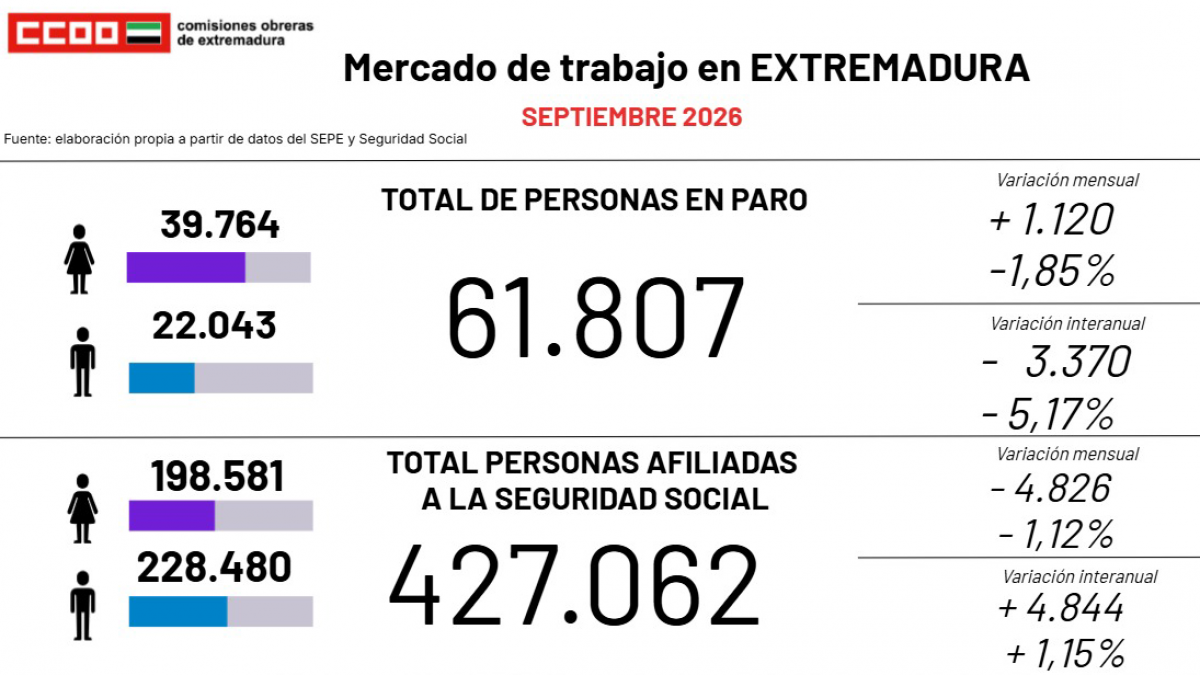
Unemployment in extremadura rose in September, with an additional 1,120 people out of work compared to the previous month. This represents a monthly increase of 1.85%, higher than the same month last year (+0.34%) and above the national average. The total number of unemployed individuals in extremadura now approaches 62,000, with women making up 64% of this figure. Data shows an increase of 807 women unemployed compared to the previous month, a rise of 2.07%, while the number of unemployed men increased by 313 (+1.44%). Currently, there are 39,764 women unemployed in extremadura, compared to 22,043 men.
In Spain overall, registered unemployment increased by 23,587 people (+1%), bringing the national total to 2,379,505. The services sector saw the largest rise in unemployment, with 1,093 more individuals out of work, followed by agriculture with an increase of 183. The industrial sector recorded 154 additional unemployed, but it experienced the highest relative growth, with a 5.1% increase from the previous month, notably in the food industry, which saw a 13% rise.
It is common for the end of the summer period to lead to an increase in unemployment due to the conclusion of seasonal activities, compounded by the end of contracts in the public administration, particularly affecting health services (+9.6%) and residential care services (+15%). Conversely, the construction sector saw a slight decrease in the number of unemployed (-27), following typical increases in July and August.
Year-on-year data continues to show a downward trend, with 3,370 fewer people unemployed compared to last year, representing a rate of -5.17%. This marks the fifth consecutive month of declining year-on-year unemployment rates, indicating a slowdown in the medium-term. The number of unemployed women decreased by 2,447 over the past year, a relative decrease of -8.80%, surpassing the decline observed among men (-4.02%).
In terms of hiring, a total of 40,919 contracts were registered, reflecting a 21.63% increase from the previous month (7,277 more contracts). Compared to the same month last year, this represents a 3.86% rise, equating to 1,519 more contracts, of which only 20% were permanent.
Affiliation to the social security system in extremadura fell by 4,826 people in September, with a decrease of 2,539 women and 2,287 men. This brings the average number of affiliations down to 427,062, returning to pre-summer levels. The relative change was -1.12%, contrasting with a national average increase of +0.41%. By regime, the general regime saw a decrease of 4,682 affiliations compared to the previous month, while there was a slight increase in the special employment regime for domestic workers (64 more affiliations). The decline in the general regime over the last month was concentrated in seasonal activities, commerce, hospitality, entertainment and sports activities, and the agro-food industry, alongside the loss of summer reinforcement jobs in public administration in health and social services.
By gender, the number of women in employment has fallen below 200,000 affiliations (198,581), while the number of men stands at 228,480. The reduction in September was fairly balanced, with a rate of -1.14% for women and -1.10% for men. Year-on-year comparisons show that employment continues to maintain positive rates, with a growth rate of 1.15% in the region (4,844 more affiliations than a year ago), although this growth is slower than the national average (+3.41%) and the lowest among all autonomous communities.