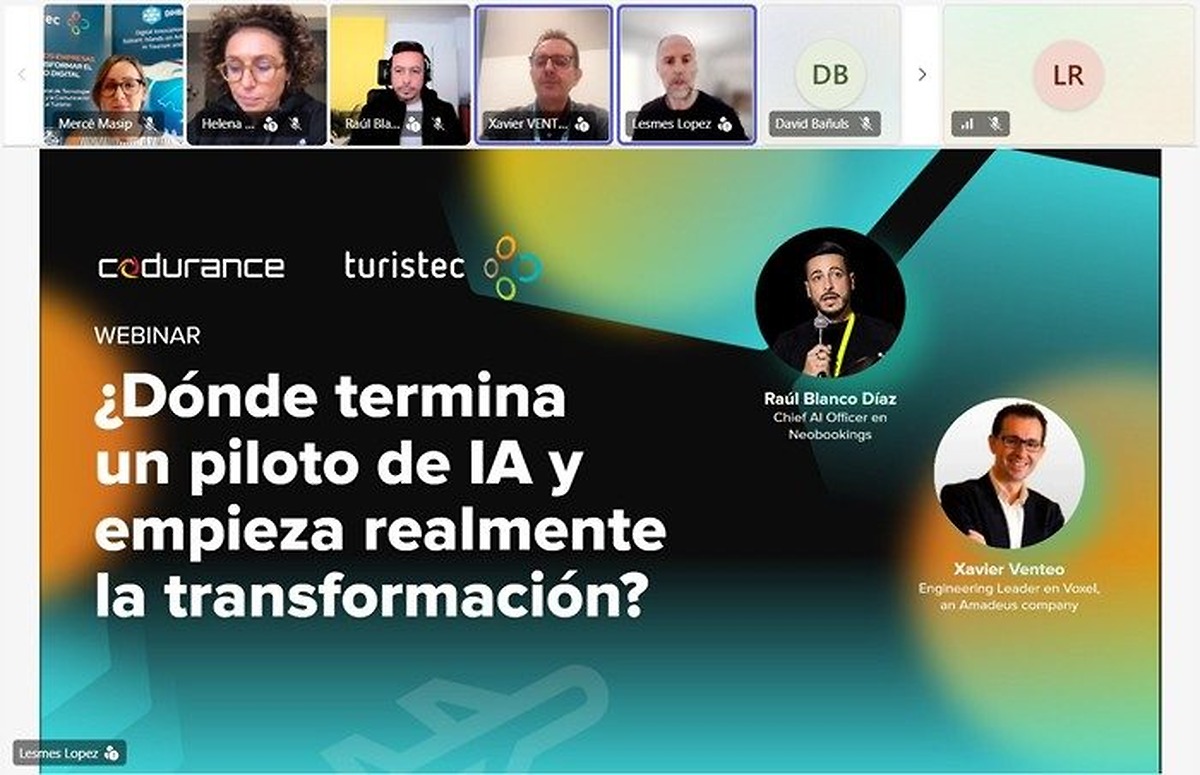
Artificial intelligence (AI) has transitioned from being an experimental technology to a strategic priority for many tourism companies. Despite the proliferation of pilots and proof-of-concept initiatives, a key question remains: how can these initiatives be transformed into real business outcomes? This was the central theme of the webinar titled 'AI in Travel: from pilot to business. How to integrate AI into data, platforms, and operations to generate real ROI', organised by Turistec in partnership with Codurance.
The session, introduced by Turistec's manager, Mercè Masip, and moderated by Lesmes López, Regional Manager of Codurance, featured contributions from Raúl Blanco, Chief AI Officer at Neobookings, and Xavi Ventero, Engineering Lead at Voxel, a company under Amadeus. It brought together professionals from the technology and tourism sectors to share experiences, challenges, and insights on the practical adoption of AI.
One of the most frequently reiterated messages during the event was that data quality “remains the differentiating factor between a promising pilot and a solution capable of generating sustained value.” The speakers agreed that many issues associated with AI stem not from the technology itself, but from fragmented, inconsistent, or dispersed data across different systems. In the hotel sector, where various systems such as Property Management Systems (PMS), Customer Relationship Management (CRM) tools, booking engines, and multiple operational tools coexist, “the integration and preparation of information becomes an essential step for models to function correctly.”
Beyond the implementation of specific tools, the discussion highlighted the need to approach AI as a process of business transformation. As presented, integrating AI is not merely about incorporating assistants, chatbots, or new generative models; it involves “reviewing processes, work methods, development methodologies, and decision-making mechanisms. The true impact occurs when technology connects with daily operations and is directed towards solving real business problems.”
The webinar dedicated a significant portion to analysing the growing role of AI agents capable of executing tasks autonomously. From generating reports to operational analysis, document management, or interdepartmental coordination, these tools have the potential to reduce repetitive tasks and free up team time for higher-value activities. In the hotel sector, specific examples were discussed related to both customer service and internal management, where agents can assist in identifying issues, prioritising actions, or coordinating operational processes more efficiently.
However, the speakers emphasised that “these systems must be developed within controlled environments, with clear operational rules and supervision mechanisms to ensure safety, response quality, and compliance with corporate policies.”
Another highlighted aspect was the necessity of establishing proper governance for AI. The speed at which prototypes can be created today necessitates careful attention to issues such as data protection, access permissions, costs associated with model consumption, and the supervision of generated results. Participants stressed the importance of “having individuals or teams responsible for coordinating AI adoption within organisations, supporting various departments, and ensuring that technology is used safely and sustainably.”
The conversation also touched on an area expected to undergo significant evolution in the coming years: the automation of payments through intelligent agents. While experts agreed that technology is advancing rapidly and autonomous payments will eventually become part of the digital experience, they reminded attendees that “there are still significant regulatory, cybersecurity, and governance challenges that must be addressed before widespread adoption can occur.”
In conclusion, the speakers recommended that companies looking to advance in this area “start by analysing their own processes, identifying bottlenecks, and detecting tasks that could be automated.” They also encouraged attendees to overcome their fear of experimenting with these technologies, always within safe corporate environments and with a clear strategy behind each initiative. As the session made clear, “the challenge is no longer about testing artificial intelligence, but about effectively integrating it to generate real and measurable impact on the business.”