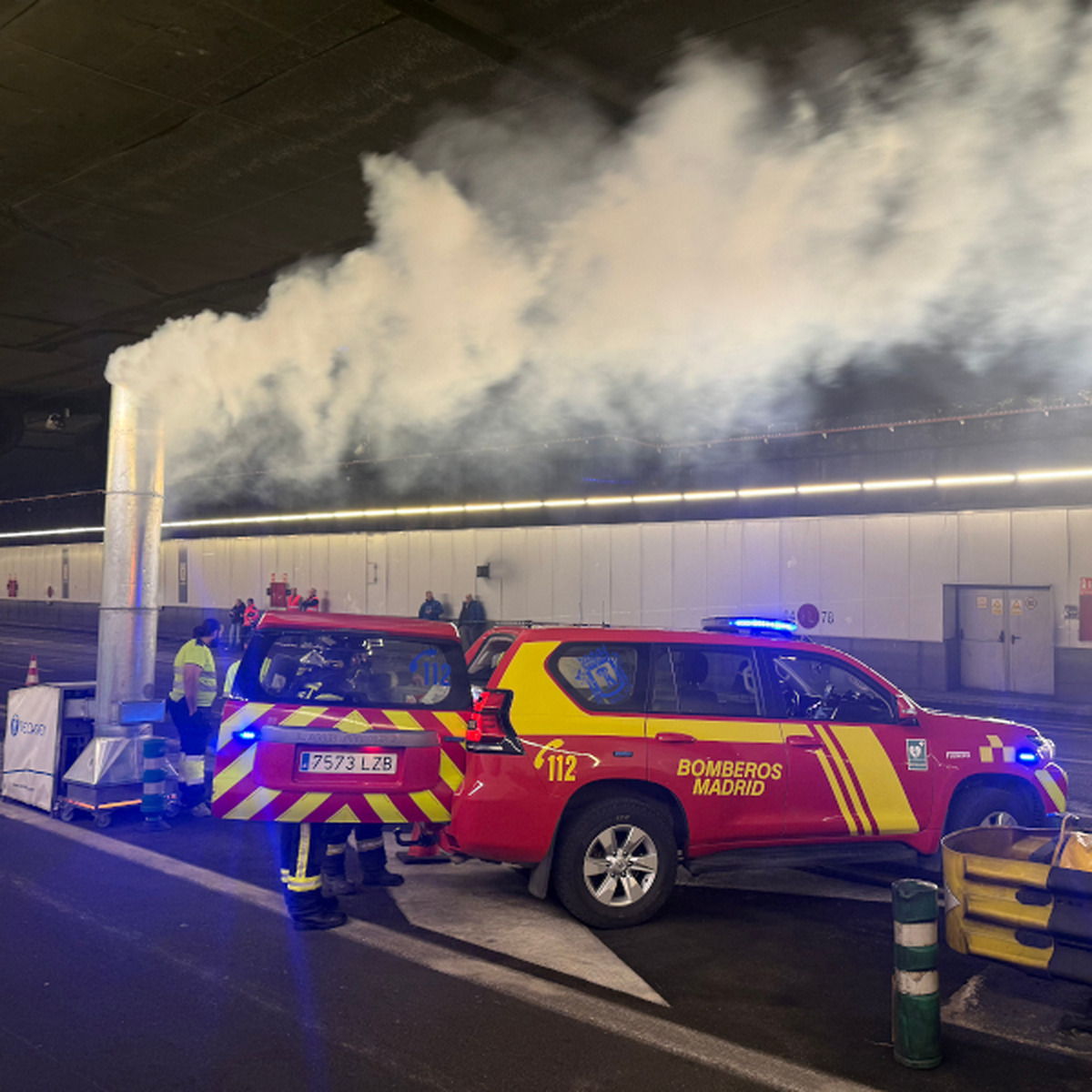
More than 200 emergency personnel participated in a night-time drill on the Avenida de Portugal tunnel in Madrid, simulating two simultaneous incidents to evaluate response times and safety protocols.
The exercise, organised by Madrid Calle 30, involved the Municipal Police, Fire Brigade, SAMUR-Civil Protection, and Madrid Calle 30 teams, who worked together to recreate a multi-vehicle accident and a fire in an electric vehicle.
Objectives of the drill
The primary aim of the drill was to assess the effectiveness of emergency protocols, evaluate reaction times, and verify the operational status of tunnel safety systems. This exercise also helps identify potential deficiencies and implement improvements in response procedures for serious incidents within this infrastructure.
Details of the incidents
The first scenario simulated an accident involving three vehicles, one of which overturned, trapping the driver inside. The other two vehicles collided while attempting to avoid the crash, resulting in a fire. Amid the chaos, a bus operated by the Empresa Municipal de Transportes de Madrid (EMT Madrid), carrying 85 passengers, had to manoeuvre sharply to avoid colliding with the wreckage.
Simultaneously, the second scenario involved a fire in an electric vehicle, which presented specific challenges due to the behaviour of the batteries. Firefighting teams had to implement protocols to manage thermal runaway risks, prevent the release of flammable gases, and control the spread of flames.
Coordination and evaluation
The detection of both incidents triggered emergency procedures from the Madrid Calle 30 Tunnel Control Centre, which coordinated the operation. The centre ordered the tunnel's closure and mobilised intervention, maintenance, and municipal emergency services.
Observers from various emergency services monitored the drill to assess team performance, compliance with protocols, and identify areas for improvement. Their evaluations will help draw conclusions about operational coordination and joint response capabilities in complex situations.
The drill also verified the functionality of tunnel safety systems, including signage, evacuation routes, ventilation, emergency lighting, and communications. Additionally, the procedures for resource mobilisation, inter-service coordination, and application of emergency and self-protection plans were assessed.
The operation concluded with a required investigation by the accident unit. Once the wrecked vehicles were removed and the road was confirmed to be in optimal condition, the tunnel was reopened to traffic.