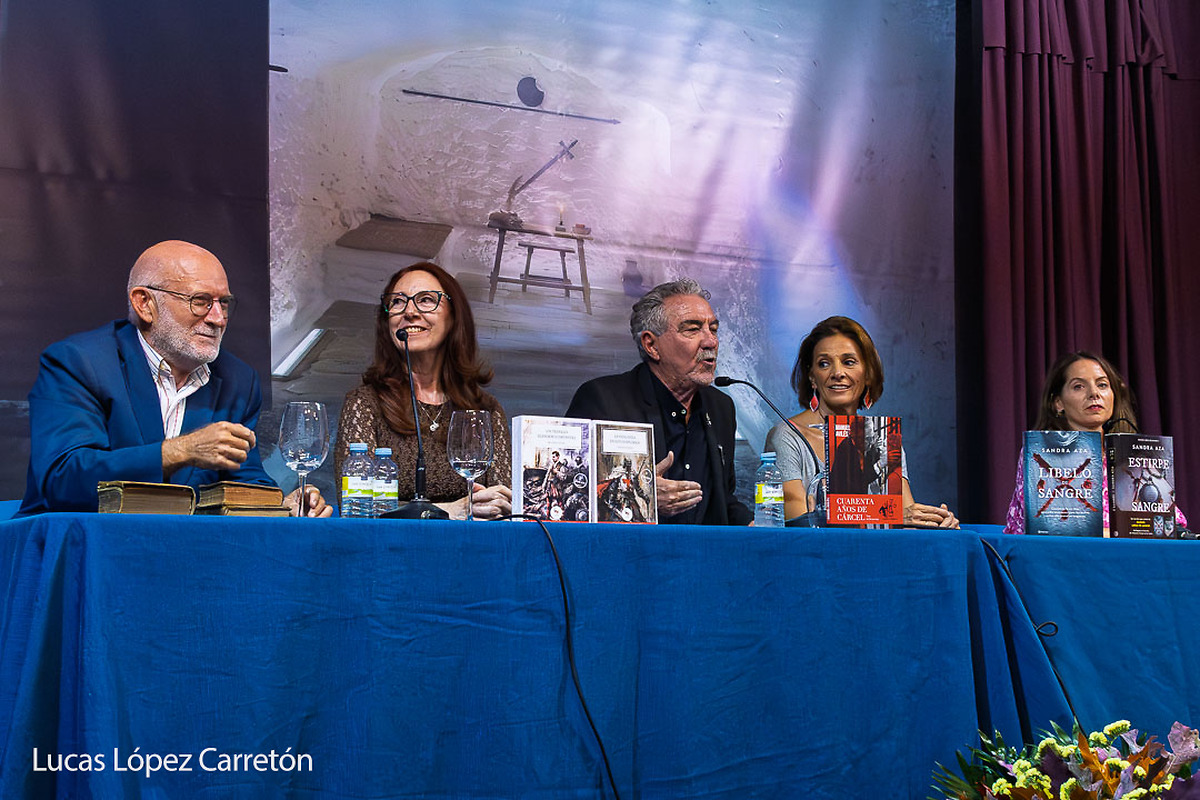
The Casa de Medrano in Argamasilla de Alba served as the backdrop for the Quijote Negro e Histórico literary event, which united writers and literature lovers in a setting of significant cultural importance linked to Miguel de Cervantes and his iconic work, Don Quixote.
Attendees included Sonia González, the mayor of Argamasilla de Alba, and Ana Cantarero, the mayor of El Pedernoso, alongside municipal representatives from both towns. Their presence underscored the cultural ties fostered through the festival Quijote Negro e Histórico.
María José Díaz, the councillor for culture, welcomed participants and highlighted the significance of hosting the event at Casa de Medrano, a site she described as integral to Cervantine tradition and the historical narrative connecting Argamasilla de Alba to the literary adventure of Don Quixote. Díaz expressed gratitude to attendees for gathering in “the place of La Mancha” and emphasised the collaboration between municipalities aimed at bringing literature to new audiences.
The event was moderated by writer Manuel Avilés, who initiated the festival Quijote Negro e Histórico in El Pedernoso. Avilés noted that the idea to host one of the festival's activities in Argamasilla de Alba emerged after he participated in a collective reading of Don Quixote and visited the Cueva de Medrano. He referred to the Quijote Negro e Histórico as a “neighbouring” festival and thanked both towns for their cooperation in making the event possible.
The day featured writers Begoña Valero, Sandra Aza, and Lide Aguirre, who shared insights into their works, research processes, and various approaches to historical and noir fiction. Valero particularly focused on Miguel de Cervantes through her book Un testigo llamado Cervantes, which is based on extensive historical research. She explained how the discovery of Cervantes' oldest known signature in a document at the Archivo del Reino de Valencia allowed her to reconstruct a narrative related to his return to Spain after five years of captivity in Algiers. Valero announced that her book is set to reach its tenth edition.
During her presentation, Sandra Aza expressed her admiration for the Cueva de Medrano and praised the municipality for preserving this heritage site. She shared that her visit to various historical locations while researching her novels had a profound impact on her, linking the cave to the Cervantine tradition of Argamasilla de Alba.
Lide Aguirre presented a different facet of noir fiction, focusing on deception, fraud, and human relationships in the digital realm. She discussed her interest in compulsive behaviours and the extent to which individuals may go through deceit, drawing from real testimonies and her investigative experiences to craft a story filled with mystery and tension.
Another participant, Manuel Desantes, a professor and artificial intelligence expert, emphasised the importance of knowledge, reading, critical thinking, and culture in the face of technological changes. He championed reading as a fundamental tool for generating knowledge and fostering individual critical judgement, referencing Cervantes and Don Quixote in his discourse.
Desantes concluded the event with a compelling discussion regarding the historical question of the “place of La Mancha” mentioned by Cervantes at the beginning of his work, strongly advocating for the narrative that associates this location with Argamasilla de Alba. He asserted, “No other town or city in Spain can compete with that narrative,” encouraging the claim to be made not only from Argamasilla but across all of Castilla-La Mancha, ultimately declaring that the town is indeed Argamasilla de Alba.
The gathering successfully established a bridge between the Quijote Negro e Histórico festival in El Pedernoso and the Cervantine tradition of Argamasilla de Alba, intertwining noir fiction, history, heritage, and literature at the Casa de Medrano, a cornerstone of the town's Cervantine imagination.