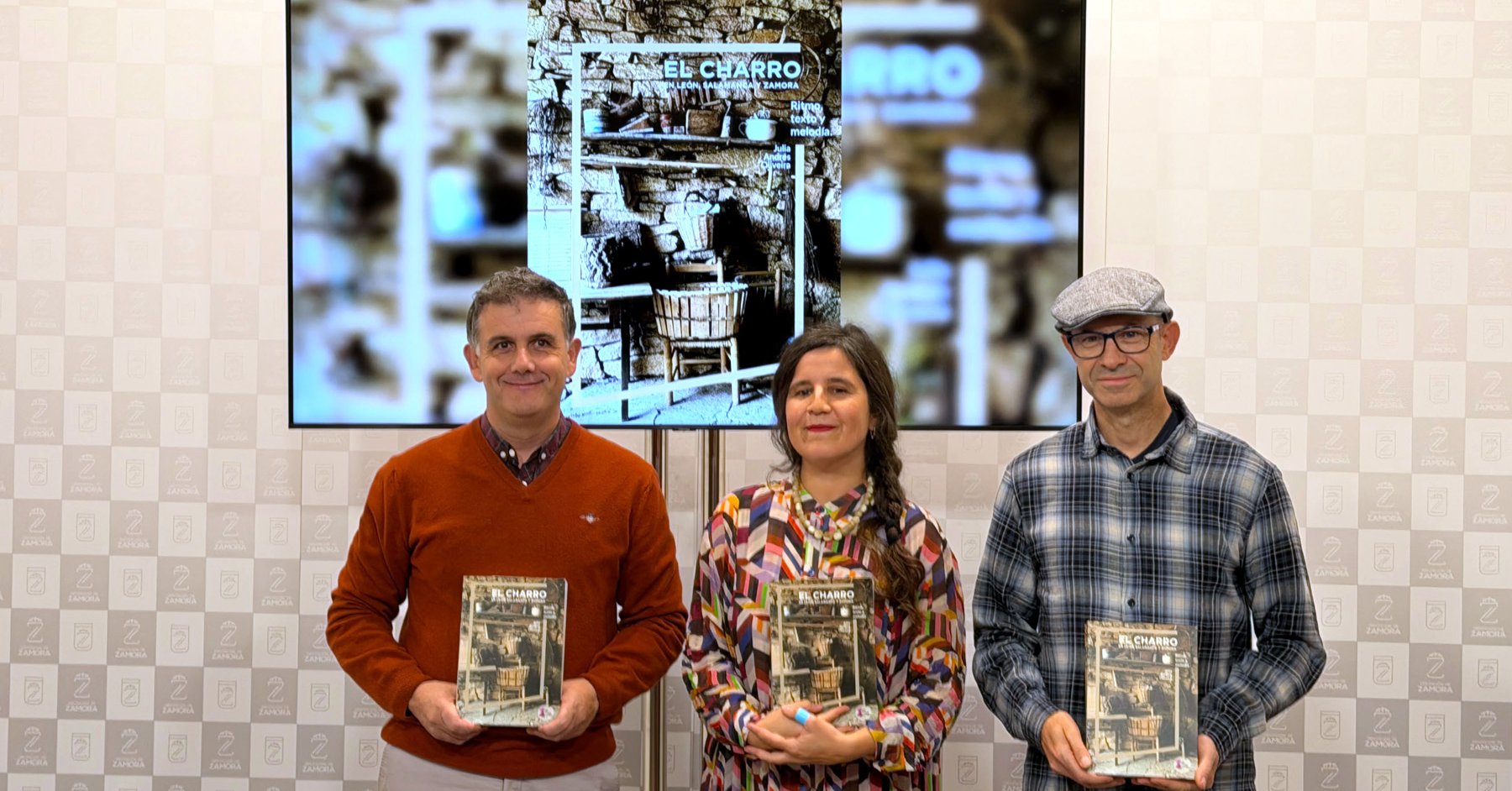
The second vice president of the Diputación de Zamora and deputy for Personnel, Internal Regime, Social Policy and Family, Ramiro Silva Monterrubio, along with Goyo Díez from Editorial Arla Folk and researcher Julia Andrés Oliveira, presented the book 'El charro en Zamora, Salamanca y León' in a press conference at the provincial institution.
This book is the result of research conducted by Oliveira, which began in 2017, focusing on the charro rhythm, a distinctive feature of the musical tradition in Salamanca, as well as in the provinces of Zamora and León. Initially an academic study that formed the basis of her thesis in 2019, it has evolved into a publication accessible to the general public. Oliveira stated, “It is important to write for academics, but it is equally necessary to share knowledge with the wider population. Otherwise, a disconnect arises between what is studied and what is being heard.”
Oliveira highlighted that this rhythm underpins much of the folklore from the former Kingdom of León. In light of the current resurgence of interest in folklore, she justified the need for such studies, which aim to provide a deeper understanding of these captivating rhythms. Throughout her career, she has frequently encountered the charro rhythm, which has always intrigued her, prompting her to study it in greater depth.
She noted that many people mistakenly associate charro exclusively with Salamanca, while Zamora boasts substantial examples of this rhythm, possibly due to its richer vocal repertoire or more extensive collection efforts. Oliveira remarked on the captivating nature of charro, explaining that its rhythm resonates with contemporary musical tastes and evokes a vital response in listeners. “It tends to generate movement, as its accentuation connects with many of the current music styles we consume. This polyrhythm creates a sensory engagement that certainly does not leave listeners indifferent,” she elaborated.
In Zamora, charro is prevalent in many regions, particularly in Sayago, and represents one of the traditional music forms of the province. Goyo Díez emphasised that the book includes a songbook featuring 239 musical scores, with 161 from Zamora, which he believes enriches the province's musical repertoire alongside works by Miguel Manzano and Maestro Haedo.
Oliveira clarified that the compilation includes dances related to the charro rhythm, many sourced from previously published written works, while others have been transcribed and incorporated into this musical corpus, providing a comprehensive historical perspective on the development of this rhythm over time.
Ramiro Silva pointed out that the research and resulting book demonstrate that this musical typology is embedded in a significant portion of local culture, often disguised under various names and contexts where its functionality changes. Therefore, given its substantial presence in Zamoran cultural heritage, the Diputación felt compelled to support this project to ensure that “this music, this tradition, endures and remains with us for future generations.”
The book is available for purchase in bookstores across Zamora. Those outside the province interested in acquiring it can contact Editorial Arla Folk via email at arlafolk@arlafolk.es.