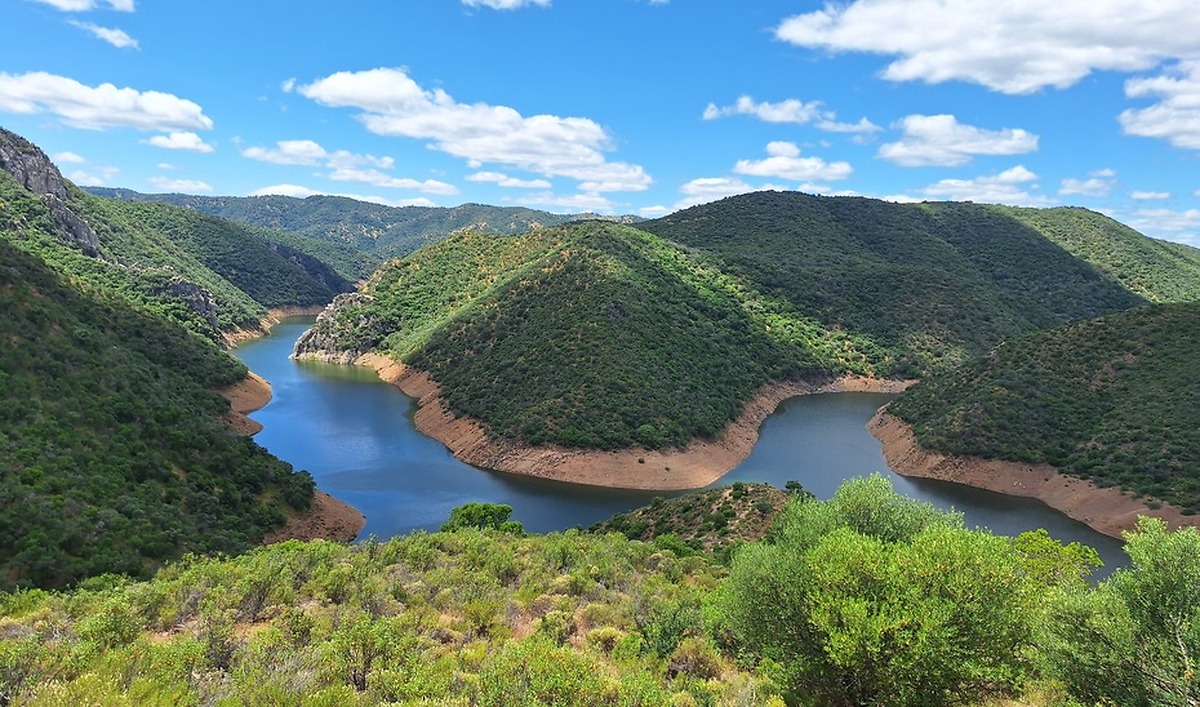
A panoramic view of the Bembézar reservoir in the Sierra de Hornachuelos Natural Park reveals a black vulture soaring above the Monastery of Los Ángeles and the rugged Peña del Salto del Fraile, which inspired the Duke of Rivas in his 19th-century play 'Don Álvaro o la fuerza del sino'. Visitors traverse the trails along the Bembézar River, immersed in the park's natural beauty.
Covering nearly 60,000 hectares, the park boasts a rich history involving hermits, nobles, and religious figures. Its historical footprint is evident in this area of significant biological diversity, which features some of the best stargazing skies in Europe, unique 'fjords' of Andalucía, and the second-largest population of black vultures in the region.
Located across the municipalities of Hornachuelos, Villaviciosa de Córdoba, Almodóvar del Río, Posadas, and Córdoba, the park is home to native flora and fauna, making it a unique space. It is part of the Dehesas de Sierra Morena Biosphere Reserve, alongside the Sierra Morena and Sierra de Aracena Natural Parks.
Jorge Paniagua, the park's director-conservator, emphasises the ecological value of the area, which contains one of the best-preserved Mediterranean and riverside forests in Sierra Morena. Visitors can explore the diverse natural landscape via the Águila, Botánico, Guadalora, Orquídeas de las Herrerías, La Rabilarga, and Los Ángeles trails.
The park's forested areas predominantly feature Mediterranean flora, with only 1.8% of its surface used for agricultural purposes. Shrub formations, including rockroses, heaths, lentiscuses, and strawberry trees, cover approximately 54% of the terrain, while dehesa formations, characterised by trees like holm oaks and cork oaks, occupy around 27%.
In addition to these, the park features open valleys with olive trees, carob trees, and palm trees, as well as riparian forests of alders, willows, and ash trees along the Guadalora, Guadiato, and Retortillo rivers. The Guadalora trail serves as the gateway to the riverside forest, where Paniagua notes, "We have the best-preserved aliseda in Andalucía," highlighting the significance of this tree species in humid areas.
Three river basins—Guadiato, Bembézar, and Retortillo—flow through the park, contributing to its distinctive features. These rivers, originating in Sierra Morena and flowing into the Guadalquivir, experience significant elevation changes over short distances, resulting in rapid waters and powerful erosive forces that have carved deep canyons and ravines, creating what are known as the 'fjords of Andalucía'.
The urban centre of Hornachuelos is situated on a limestone enclave, giving rise to its 'hanging houses' and the Cañón de la Pasada de Algeciras, a valley shaped by the Guadalora River. This geological feature allows for the observation of marine fossils, remnants from when the sea reached Hornachuelos five million years ago.
The black vulture is the dominant species in the park, which hosts one of the largest colonies in Andalucía, second only to the Sierra Pelada and Rivera del Aserrador Natural Area in Huelva. According to the latest census from 2020, the park and its surrounding area housed 92 pairs of these birds, which can be spotted from various locations. Other species include griffon vultures, golden eagles, imperial eagles, and black storks.
Autumn and spring are the preferred seasons for many visitors drawn to the park's natural heritage. The 'Huerta del Rey' visitor centre, located in the recreational area of the same name, serves as a starting point for several public trails and includes a kiosk-restaurant.
Currently, a project is underway, in collaboration with other public administrations, to connect two trails along the Bembézar River via a 'tibetan bridge' over the waters of the Hornachuelos reservoir. Initiatives to explore the region's seasonal flowers and plants, such as spring orchid sessions, mushroom days, full moon and stargazing events, deer rutting workshops, and nocturnal raptor photography classes, have taken place over the past year.
The reservoirs surrounding the park—La Breña, Bembézar, El Retortillo, and Hornachuelos—offer additional attractions for visitors. One of the most popular activities is the solar boat ride on the Bembézar reservoir, providing opportunities to observe local flora and fauna while learning about points of interest, including the aforementioned 'fjords'.
The clarity of the night skies has led to the designation of Sierra Morena as a Starlight Reserve, recognised as the largest protected area in the world for stargazing. In light of this, the 'Huerta del Rey' visitor centre will soon open 'La Noche: Cielos de Sierra Morena', an exhibit recreating the night skies visible in the area.
The park's rich flora is also leading to a renewed appreciation for its existing orchids. On the 'Orquídeas de las Herrerías' trail, nearly 20 different species have been identified, and a process of signage is being developed to establish interpretative routes from January to June, aimed at enhancing knowledge of these plants. Paniagua notes that the goal is to move towards a "more specialised tourism".
To further this aim, efforts are underway to promote the park as a cycling tourism destination. It is integrated into a cycling route that spans the entire Biosphere Reserve, from Encinasola (Huelva) to Posadas (Córdoba). Activities promoting nature integration, such as 'forest bathing' to alleviate stress, are also planned, along with the installation of a butterfly garden featuring local species.
The historical legacy of the Sierra de Hornachuelos is palpable, including the story of Brother Mateo de la Fuente, a disciple of San Juan de Ávila and hermit in the Córdoba wilderness, who, along with Brother Diego Vidal, settled as hermits in a mountainous area, which became the foundation of the Monastery of San Basilio del Tardón, inhabited by monks until 1808. This is not the only religious structure in the area, as Paniagua recalls, "We are talking about a region with a significant spiritual heritage, often chosen by hermits." The walls of the 15th-century Monastery of Los Ángeles, belonging to the Franciscan order, also emerge from these landscapes.