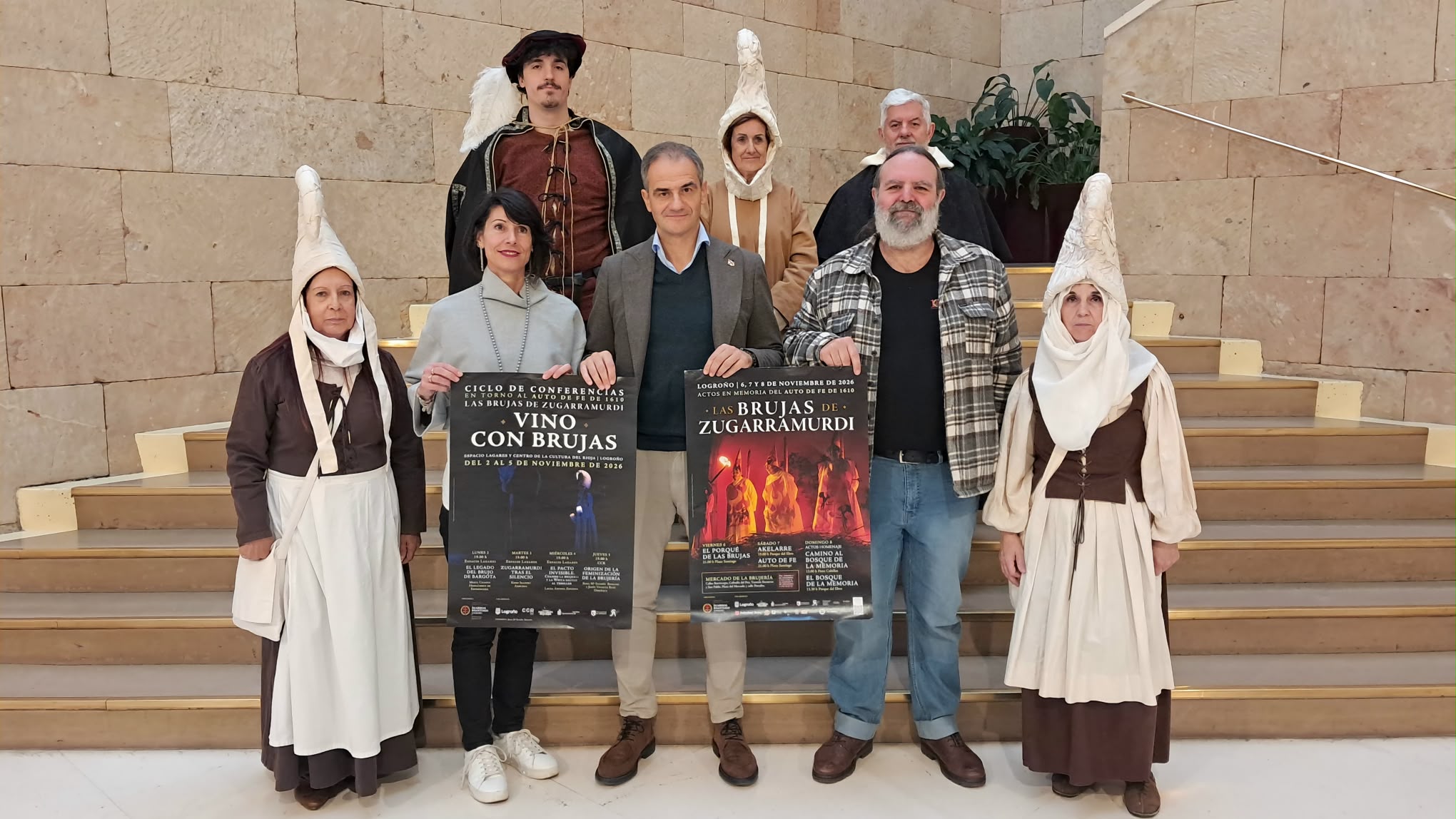
The Historical-Cultural Association Guardias de Santiago, in collaboration with the Ayuntamiento de Logroño, has organised an extensive programme surrounding the Auto de Fe of 1610, during which the so-called ‘Las Brujas de Zugarramurdi’ were judged. The aim of these events is to promote culture, memory, and community engagement among residents and visitors alike.
City councillor for Promotion, Miguel Sainz, alongside Nacho Tobía, vice president of the Historical-Cultural Association Guardias de Santiago, researcher and historian Rosa Sandín, and several association members, emphasised that this cultural and social event has become a staple in the city. It not only attracts the interest of locals but also draws thousands of visitors from La Rioja and beyond. Last year, over 25,000 people attended the activities.
These events commemorate the Auto de Fe of 1610, regarded as the most significant event of the Spanish Inquisition. During this process, 53 individuals were judged, with eleven condemned to death by burning, accused of witchcraft. More than 30,000 people attended the event in a city that then had a population of only 6,000.
Sainz highlighted that the aim of these events is to provide learning opportunities and reinforce values of respect and justice, recreating the past to prevent its repetition. The programme features activities for all ages, including parades, family workshops, theatrical performances, a medieval market, and exhibitions.
New features in this year's programme
This year's programme includes significant changes, such as the relocation of the Witch Market from Paseo del Espolón to the streets of Barriocepo, Cofradía del Pez, Travesía Excuevas, San Pablo, Plaza del Mercado, and Portales. Tobía noted that there will also be new performances, including the transfer of the witches from Pozo Cubillas. The main performances will take place in Plaza de Santiago.
The Witch Market will be inaugurated on Friday, 6 November, at 5:00 PM in its new location, featuring puppet theatre, guided tours of an exhibition on punishment tools from the Inquisition, and various street theatre and magic performances. At 9:00 PM, the play ‘El porqué de las brujas’ will be staged, providing context to the society of 1610.
On Saturday, 7 November, activities will begin at 11:00 AM with children's workshops running until 1:00 PM. Highlights include the Akelarre and subsequent arrest of the witches at 7:00 PM, followed by the representation of the Auto de Fe of 1610 in Plaza Santiago at 9:00 PM. The day will also feature storytelling, parades, puppet theatre, guided tours, and magic shows. The Saturday programme will conclude with a live concert by Grimorium in Plaza de Santiago.
Sunday, 8 November, will also commence with a parade from Plaza del Mercado, followed by various activities such as calligraphy workshops, scavenger hunts, and guided tours. At 12:00 PM, an unprecedented event will take place with the transfer of the witches from Pozo Cubillas. At 1:30 PM, a tribute to the victims of the 1610 inquisitorial process, titled ‘El bosque de la memoria’, will be held in Parque del Ebro. The weekend will conclude with the final festive performance, ‘El baile de los malditos’, at 7:30 PM in Plaza de Santiago.
Throughout the weekend, visitors can explore the exhibition ‘Herramientas de castigo y pena capital de la inquisición’ at Aparcamiento Barriocepo, and ‘El bosque de los libros prohibidos. Hay silencios que también necesitan ser leídos’ at Plaza del Mercado.
Pre-event lectures
The activities are not limited to the weekend of 6 to 8 November; they will also include a series of lectures leading up to the events, titled ‘Vino con brujas’. From 2 to 5 November, the Espacio Lagares and the Centro de la Cultura del Rioja will host four talks where experts will delve into the history, myths, and legends surrounding this significant anniversary. The lectures will take place at 7:00 PM and will be paired with a glass of Rioja wine.