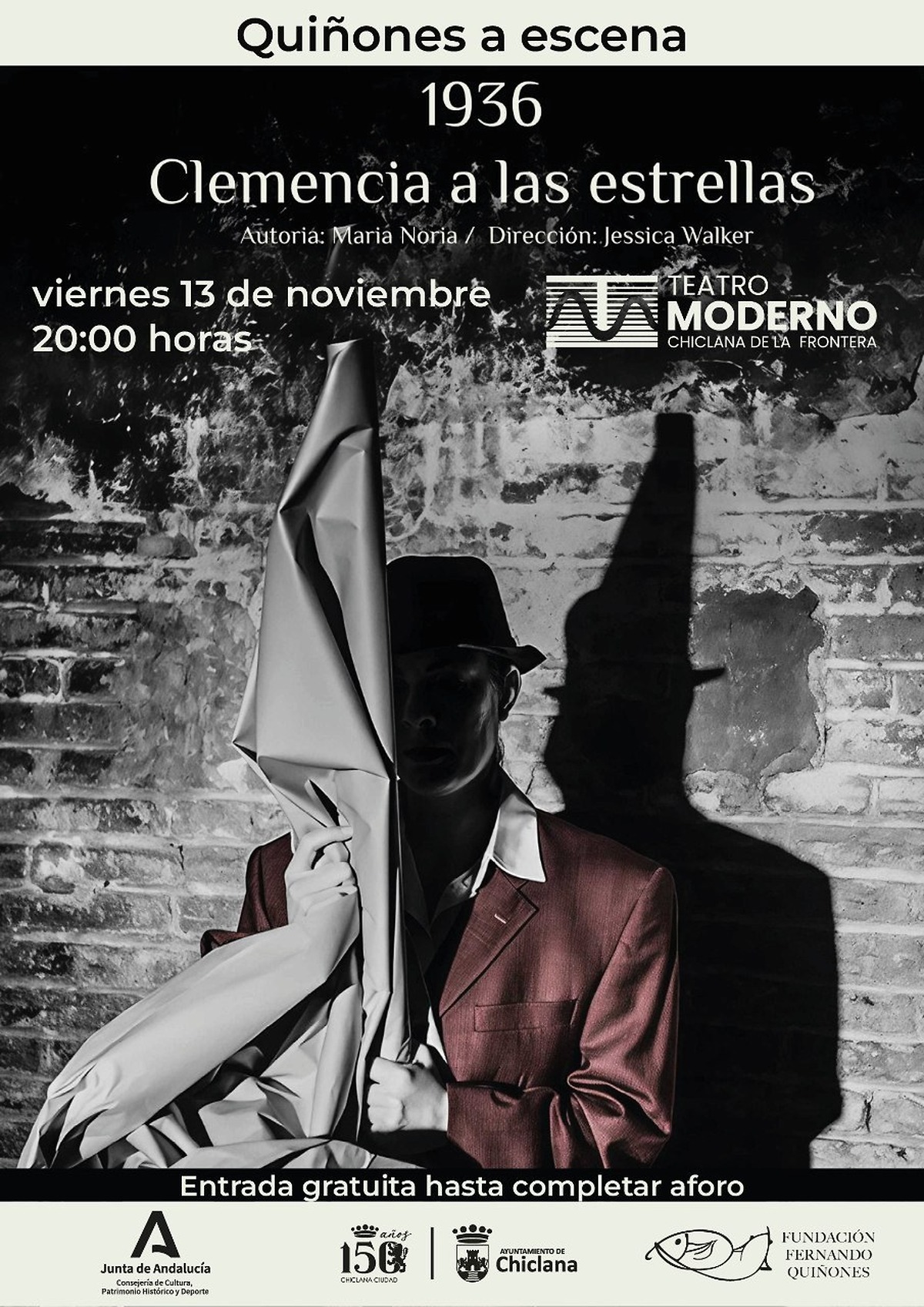
The theatre company MariKa conK will present the play ‘1936. Clemencia a las estrellas’ at the Modern Theatre in Chiclana on Friday, 13 November. The performance focuses on the life, work, and tragic death of Agustina González López (1891-1936), a politician, writer, and artist known as ‘La zapatera’. She shared a deep passion for theatre and a close friendship with the renowned Spanish poet Federico García Lorca, both of whom met a tragic end in Viznar, Granada.
Scheduled for 20:00, the event is organised by the Fernando Quiñones Foundation and sponsored by the Andalusian Agency for Cultural Institutions of the Junta de Andalucía. Entry is free and available on a first-come, first-served basis.
MariKa conK, a feminist theatre company founded in mid-2024, aims to highlight historical memory through its productions. The play features a solo performance by its author, María Noria, under the direction of Jessica Walker, a graduate of acting from the University of Chile. Walker, known for her involvement in experimental theatre and as the founder of the Dramatic Body Expression Laboratory in Barcelona, promises a presentation that is both stark and intense, showcasing Noria's acting prowess and bringing to light a largely unknown historical backdrop.
Noria and Walker describe Agustina as a figure who challenged her era through art, free thought, and an unwavering belief in humanity. The play explores her founding of a political party, her choice to wear trousers at a time when such attire was socially unacceptable, and her openly feminist stance. “This work invites complicity with her legacy and encourages reflection on the impact of her thoughts and actions in society,” they assert.
The dramaturgy is crafted from Agustina's own writings and the historical context she was unable to narrate herself, resulting in a poignant portrayal of a woman ahead of her time, driven by an unshakeable faith in humanity. The narrative takes the audience on an intimate, political, and emotional journey that resurrects her voice and an overlooked era.
Agustina González López was born on 4 April 1891 into a well-off family involved in the shoe industry, which later earned her the nickname ‘La zapatera’. During the 1910s, Granada faced significant social challenges, including poverty and illiteracy, prompting Agustina to engage in protests and gain prominence in the political landscape. She was affiliated with the Socialist Group of Granada and founded a Women's Group in March 1919, which boasted around 200 members. However, after a troubling incident at the Teatro Cervantes, she distanced herself from politics until 1933, when she established the Whole Humanist Party and ran for election, receiving only fifteen votes.
In 1927, she began writing ‘Las leyes secretas’, reflecting her ideological principles and spiritual beliefs. Notably, she self-published and sold her works from her shoe shop, using the pseudonym Amelia. Her close relationship with Lorca is also significant; his correspondence often highlights Agustina, and her influence is evident in his works, including ‘La zapatera prodigiosa’ and the character Amelia in ‘La casa de Bernarda Alba’. Like Lorca, Agustina was executed in Víznar in August 1936, just a month after the onset of the Spanish Civil War, likely due to her ideological beliefs.