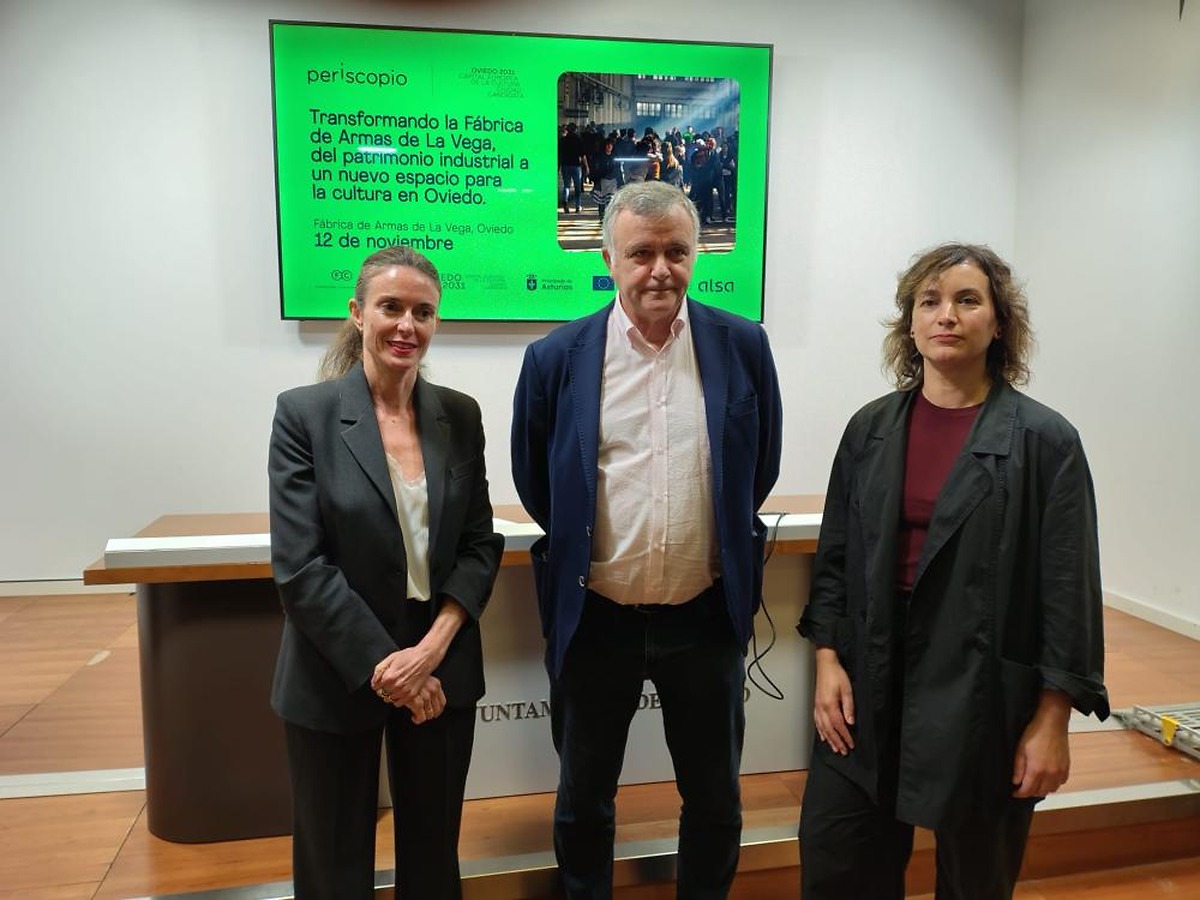
PERISCOPIO Oviedo, an initiative organised by the candidacy of Oviedo for the title of European Capital of Culture 2031 and Fundación Contemporánea, will take place on 12 November. The event aims to gather international cultural professionals and managers to share experiences regarding the recovery of industrial heritage and explore future possibilities for the former Fábrica de Armas de La Vega.
The presentation of the event was held at the press room of the Ayuntamiento de Oviedo and featured Rodolfo Sánchez Farpón, director of the Oviedo 2031 candidacy, and Sara Magán, director of Fundación Contemporánea. La Vega is a key component of Oviedo's bid for the European Capital of Culture title, highlighting its potential as a space for creation and community engagement.
“The recovery of the former Fábrica de Armas de La Vega, due to its size, heritage significance, and connection to the city, is a priority in our proposal for capital status. It is a fundamental part of Oviedo 2031, as it will provide the facilities necessary to develop the extensive cultural programme we are defining for the next nine years,” stated Sánchez Farpón.
During the event, attendees will have the opportunity to engage in discussion panels and a participatory session aimed at gathering ideas, proposals, and concerns regarding the future of La Vega. The event is free and open to the public, but prior registration is required through the Fundación Contemporánea website.
The programme will also include “Siéntate a la mesa,” a participatory session designed to give voice to the local community and involve them in discussions about the future of La Vega. Participants will be able to share their thoughts and suggestions regarding the potential of this space and its relationship with city life. Zoe López Mediero, co-artistic director of Oviedo 2031, and Marcella Ciacci, author of The 99, a guide to 99 pioneering art centres worldwide, will also participate in this session. The day will conclude with a summary of the main reflections from the discussions.
Beyond the preservation of its buildings, the recovery of La Vega poses challenges related to citizen participation, the coexistence of heritage and contemporary creation, and its integration into the cultural and social life of Oviedo. Among the participating projects are Fabra i Coats in Barcelona, an old factory transformed into an artistic creation space; Poligon Creative Center in Ljubljana, Slovenia, focused on creative industries and innovation; and DEPO2015 in Pilsen, Czech Republic, an old bus depot converted into a cultural and creative centre. Representatives from international organisations such as Trans Europe Halles and ICOMOS, which are involved in the revitalisation of cultural spaces and heritage conservation, will also be present.
“PERISCOPIO was launched in 2022 with the aim of strengthening the cultural sector. In Oviedo, it will feature a dozen international voices that have successfully transformed industrial heritage into cultural containers. We want to learn from them, understand their advice, and identify potential pitfalls and successful strategies,” explained Magán.
The programme will include activities for international participants, including a visit to the former Fábrica de Armas de La Vega, allowing them to experience the characteristics of this industrial complex first-hand. Additionally, these participants will hold a closed-door working session to share their experiences and reflect on the challenges and opportunities presented by the recovery of such facilities.
PERISCOPIO Oviedo is part of the ongoing process of building Oviedo's candidacy for the European Capital of Culture 2031, which promotes culture as a tool for social transformation, cooperation, and territorial development. The initiative aims to facilitate knowledge exchange between international professionals and Asturian cultural agents, incorporating new perspectives into the debate on the future of La Vega. With this edition, Oviedo joins PERISCOPIO, an initiative by Fundación Contemporánea that connects cultural professionals from various parts of Spain to share experiences, address common challenges, and create collaboration opportunities. Cities such as Cáceres, Málaga, Valencia, Granada, and A Coruña have previously hosted these meetings, which contribute to strengthening the ties between cultural agents in each territory.