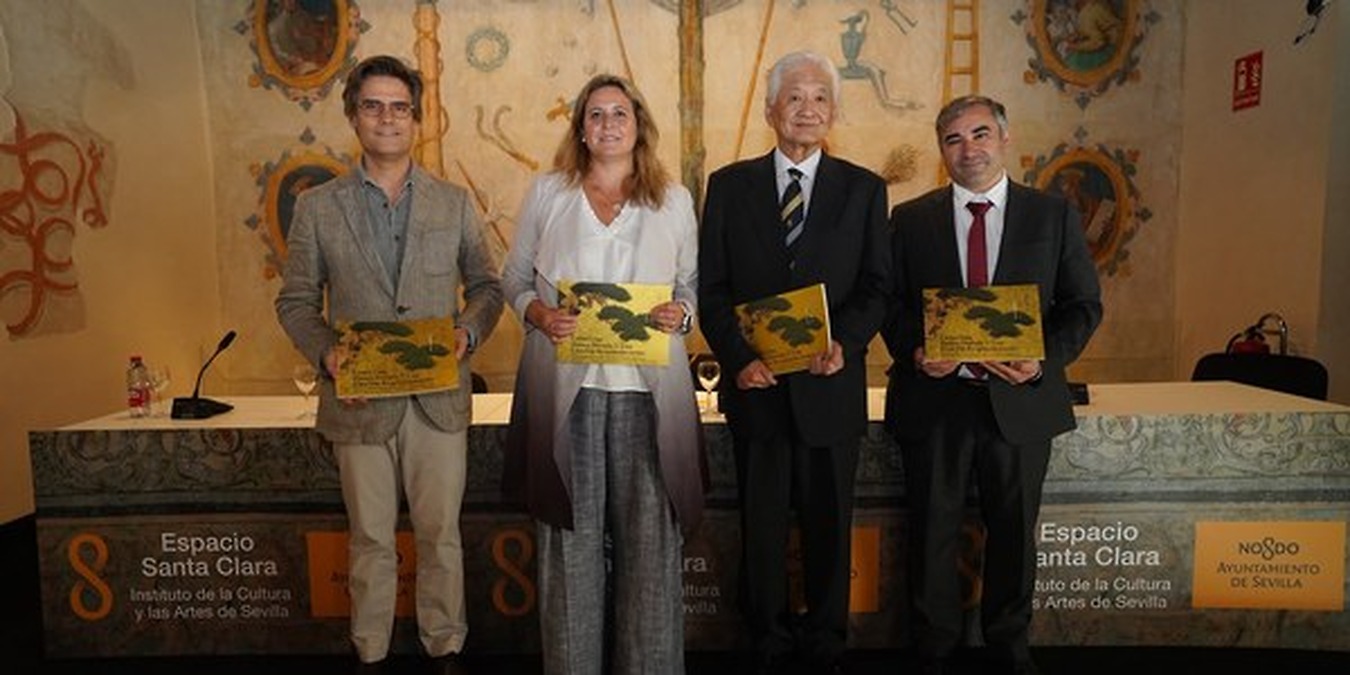
The city council of Seville has unveiled the exhibition ‘KINPAKU. Nature, power and imagination in Japanese art’ at the Espacio Santa Clara, which will run from 20 October 2026 to 10 January 2027. This showcase offers a journey through four centuries of Japanese art, highlighting kinpaku, or Japanese gold leaf, a material that significantly alters the perception of the artworks.
During the presentation, Angie Moreno, the city’s delegate for Tourism and Culture, was joined by the exhibition curators, Professor Hiroyuki Kano, an expert in Edo period painting and former director of the National Museum of Kyoto, and Japanese art specialist Daniel Sastre de la Vega. Moreno stated, “Seville needs cultural proposals that broaden the perspective of its residents and visitors, and KINPAKU is an extraordinary example of this. We are committed to initiatives that blend tradition and innovation, inviting us to view craftsmanship as a living art form rather than a relic of the past.”
Moreno welcomed the exhibition as “an exceptional opportunity to immerse ourselves in a tradition of delicate beauty and profound meaning that continues to captivate humanity,” emphasising the honour of hosting such a remarkable display in Seville, a city historically known for its openness to cultural exchange.
The exhibition, curated by Professor Kano and Dr Sastre de la Vega, places gold at the forefront. Its ability to capture, reflect, and transform light alters the perception of the artworks and the space they inhabit. The gold backgrounds feature motifs such as pines, cranes, flowers, birds, snowy landscapes, and scenes from Japanese tradition, creating a universe where nature, power, spirituality, literature, and daily life intertwine. “No photograph can convey how light makes the gold leaf vibrate, like a silent dance,” explained curator Daniel Sastre.
The heart of the exhibition: byōbu
The core of the exhibition consists of byōbu, traditional Japanese folding screens. Their name literally means “to block the wind,” but their function extended far beyond practicality: they defined and solemnised spaces, were present at births, weddings, banquets, and funerals, and served as diplomatic gifts among Japanese elites. The selection includes large compositions designed to transform a room, alongside smaller screens intended for intimate spaces, featuring motifs such as bamboo forests, peonies, insect cages, autumn grasses, and scenes from The Tale of Genji.
The sixteen fans complement the exhibition with designs inspired by Japanese mythology and literature, including a phoenix on a paulownia tree, the legend of Tōbōsaku and the peaches of immortality, and a scene from The Song of Eternal Regret. The exhibition pays particular attention to the Momoyama (1573–1615) and Edo (1615–1868) periods, which were crucial for the establishment of grand golden screens, where gold became associated with the representation of authority. The Kanō school and the figure of Kanō Eitoku are essential to understanding this development.
Parallel activities
The exhibition will officially open on 20 October at 19:30, with the curators and representatives from the Japanese Embassy in attendance. On 21 October at 11:00, Professor Hiroyuki Kano will lead a public guided tour, and on 27 October at 17:00, a conference on kintsugi and the use of gold in Japanese art will feature the Japanese ambassador to Spain, Hiroshi Yamauchi. Additionally, from October to December, Espacio Santa Clara will host a series of free public lectures every Wednesday at 17:00.
“Initiatives like KINPAKU demonstrate that Seville is, and wishes to remain, a city of vibrant culture: a city that cherishes and champions its own heritage while also embracing other traditions and ways of understanding art. The fact that pieces created four centuries ago in Japan can still resonate with us today at Espacio Santa Clara is the best proof that culture knows no boundaries or eras,” concluded Angie Moreno.
Exhibition details
Title: KINPAKU. Nature, power and imagination in Japanese art
Date: 20 October 2026 to 10 January 2027
Location: Espacio Santa Clara
Hours: Tuesday to Saturday, 10:00 to 20:00; Sundays and holidays, 10:00 to 14:00; closed on Mondays
Admission: Free until capacity is reached