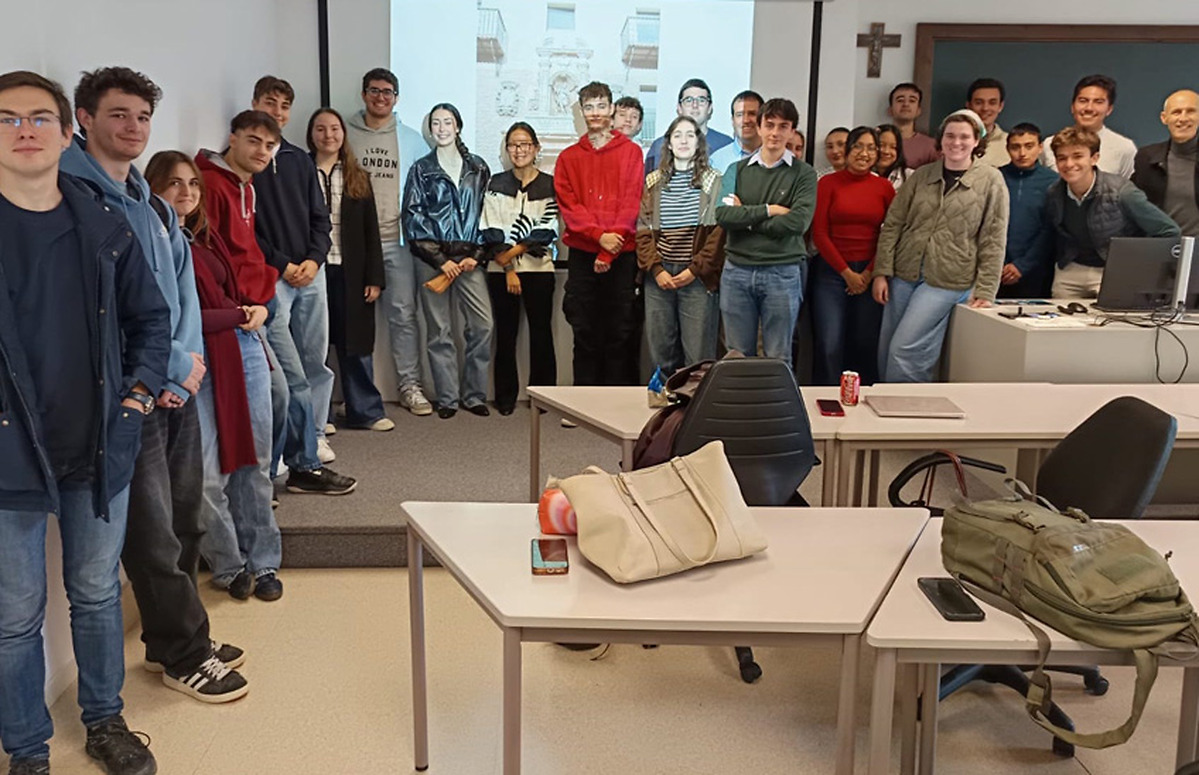
Students enrolled in the course 'Renaissance, Baroque and Enlightenment in Europe', part of the History, Archaeology, Journalism, and International Relations degrees at the University of Navarra, recently visited the Pamplona Municipal Archive. Accompanied by Professor Javier Azanza, they had the opportunity to explore an exceptional collection of hieroglyphs created for royal funeral ceremonies held at the Pamplona Cathedral during the 18th century.
During the visit, Professor Azanza explained the nature and significance of these compositions, which were designed as visual puzzles serving to commemorate deceased monarchs. Created as large cards, these elements were incorporated into the funerary tumulus or catafalque, a monumental structure with multiple stepped bodies that served as the visual and symbolic centre of the ceremonies.
The collection conveyed a message that began with the expression of grief from the subjects of Pamplona and Navarre over the loss of their sovereign, continued with reflections on the universality of death, and concluded with the idea of triumph over death through the virtues of the deceased king or queen. This not only assured them eternal life but also positioned them as role models for their subjects. In royal funerals, the continuity of the dynasty was also highlighted, ensuring the stability of the monarchy.
Formally, the hieroglyphs followed the model of the triplex emblem popularised by Alciato, consisting of a Latin motto, an allegorical image (pictura), and a poetic epigram in Spanish. The Pamplona Municipal Archive houses nearly a hundred of these hieroglyphs, belonging to the funerals of Felipe V (1746), Bárbara de Braganza (1758), Isabel de Farnesio (1766), and Carlos III (1789).
Professor Azanza noted that studying these pieces offers a unique opportunity to engage with the manifestations of ephemeral Baroque art, stating, 'The collection of Pamplona hieroglyphs represents a truly exceptional set and one of the great treasures of the archival and documentary heritage of Navarre.' The visit allowed students to delve deeper into the interpretation of these pieces and discover how, through the combination of text and image, the funerary ceremonies of the Ancien Régime articulated complex discourses on death to construct royal memory and legitimise the monarchy.