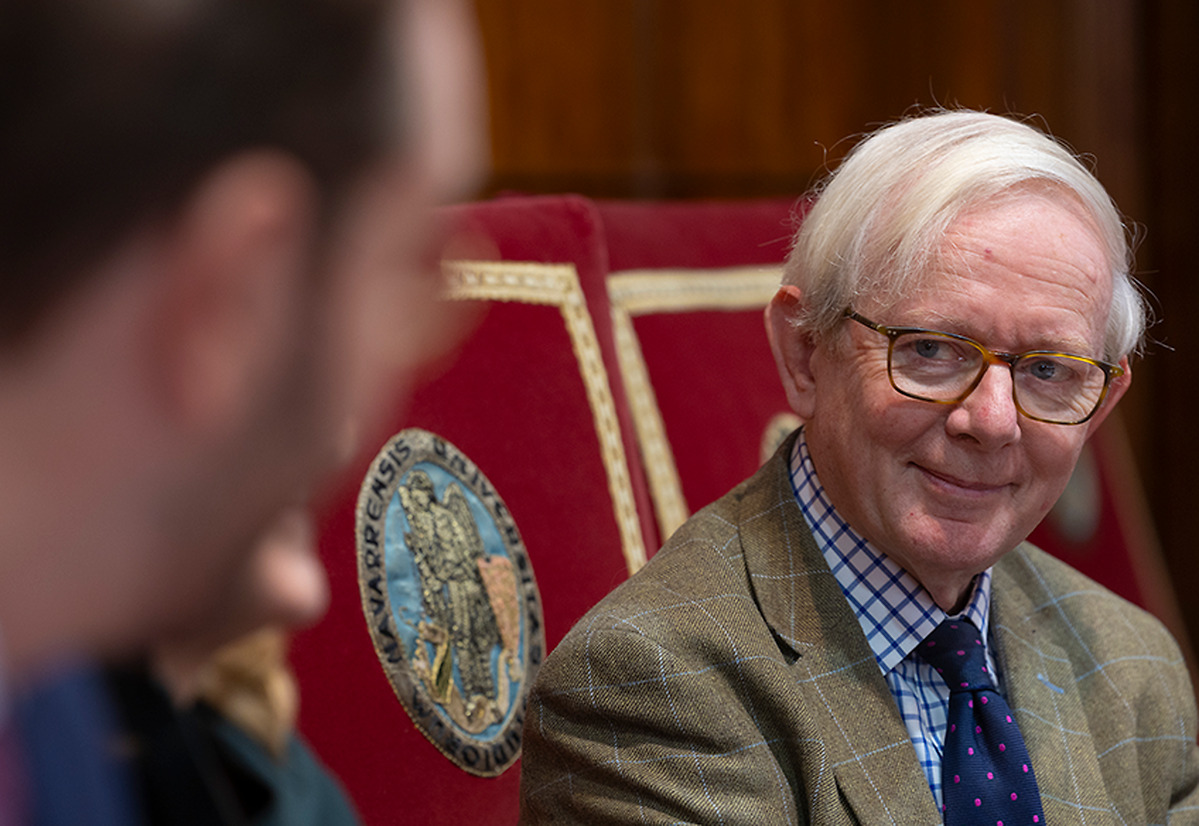
Paul Shrimpton, a professor at Magdalen College School in Oxford, discussed the principles of liberal education, the tutorial system, and character formation in the thought of john henry newman during the inaugural Newman Conference held at the University of Navarra. The event took place on 29 October in the Aula Magna of the Central Building, organised by the Core Curriculum Institute and Friends of Newman, and was presided over by Rosalía Baena, Vice-Rector for Students, alongside Péter Heltai, a doctoral student from the Faculty of Education and Psychology.
In his lecture titled Newman’s eminent teaching on university education, yesterday and today, Shrimpton portrayed Newman not only as an intellectual but also as “a man of action.” He dedicated himself to establishing the Catholic University of Ireland in 1854. According to Shrimpton, Newman had a broad conception of education, resisting the trend to narrow its meaning. “Education takes place not only in formal settings like the classroom but also in informal activities such as sports, music, and theatre,” he stated.
Shrimpton highlighted Newman’s significant role in reforming the University of Oxford, contributing to the foundation of the modern tutorial system. He cautioned that reading Newman can be challenging but noted that the cardinal believed understanding the truth of an idea requires viewing it from multiple angles. Newman argued that the purpose of education is to cultivate good members of society, and from a supernatural perspective, it should lead to Christian holiness.
The professor also emphasised the necessity of interdisciplinarity in education and advocated for a liberal education, where knowledge is an end in itself. “A liberal education shapes the mind in the way of making judgments,” he asserted. Towards the end of his presentation, he recalled Newman describing an academic system devoid of personal influence from professors as “an arctic winter.”
Shrimpton concluded his lecture by presenting Newman as a “herald of hope,” reminding the audience that Newman’s life was marked by disappointments and failures, and that he understood hope as a resilient virtue. Following the lecture, a roundtable discussion on liberal education and the future of the university took place, alongside the premiere of the documentary Lead Kindly Light: The Story of Saint John Henry Newman.