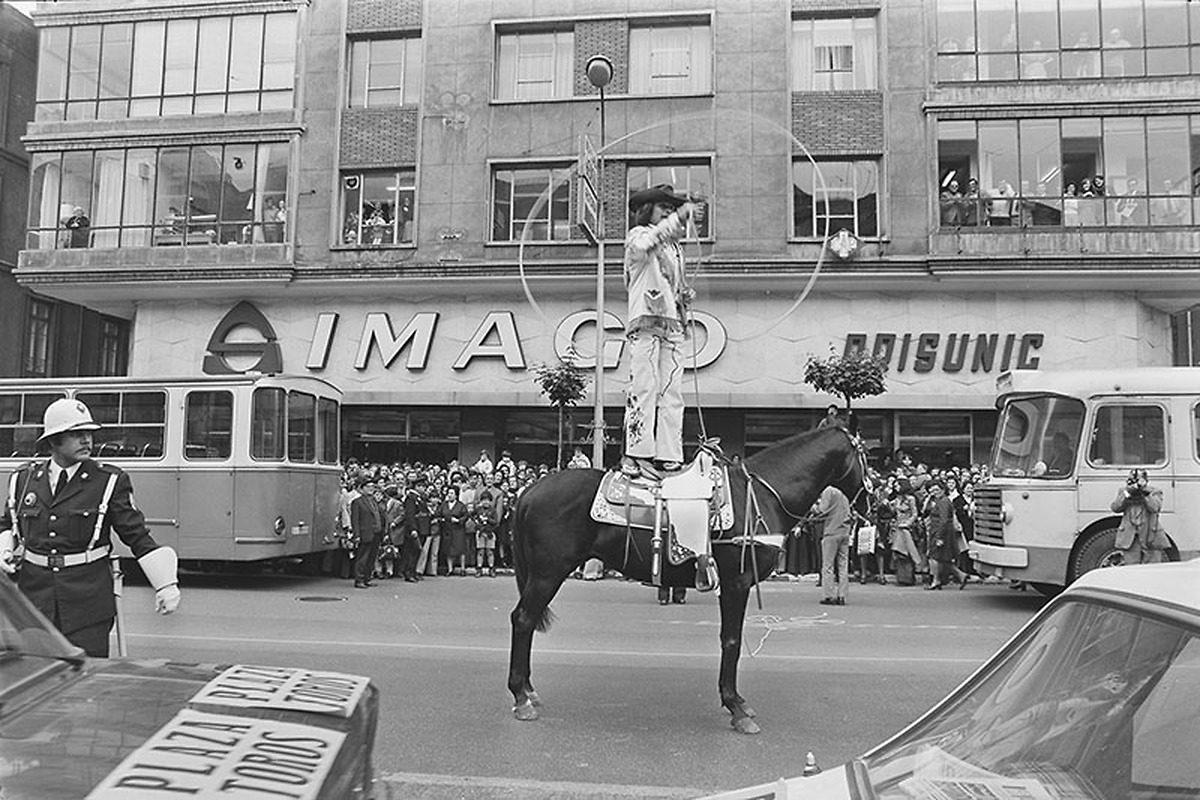
A total of 69 images capturing Santander during the 1970s and early 1980s, taken by photographer Juan Antonio Mazo, will be displayed in an exhibition opening on 15 October at 18:00 in the Paraninfo of the University of Cantabria (UC). The exhibition will be open for public viewing until 12 February, from Monday to Friday, between 17:00 and 20:00.
Organised by the UC's Area of Exhibitions under the Vice-Rectorate for Culture and Society Transfer, the exhibition is supported by the Cantabria Parliament and the Cultural Association Archivo Foto Mazo, which is responsible for preserving this significant photographic legacy.
Titled 'The lens on change: Santander through the photography of Juan Antonio Mazo (1970-1982)', the exhibition aims to illustrate the profound transformations that occurred during the transition to democracy in Santander, paralleling developments across Spain. According to Rebeca Saavedra Arias, the Vice-Rector for Culture and Society Transfer, the exhibition will highlight both changes and continuities that contribute to reconstructing the collective memory of this period.
Saavedra Arias added that the exhibition also seeks to honour the figure and work of Juan Antonio Mazo, whose contributions are crucial for visually analysing the realities of Santander and Cantabria during the Franco regime and the transition period.
Juan Antonio Mazo (1925-1999) produced an exceptional body of work that documents his time with a unique, insightful perspective deeply engaged with his surroundings. Using his iconic Leica camera, Mazo captured significant moments, spaces, and figures from the final years of Franco's regime and the subsequent transition to democracy.
The exhibition's curatorial team includes historians Adrián Magaldi, Jesús Movellán, Bernardo Riego, and Nuria García, who is also the director of the UC's Area of Exhibitions. They have focused on selecting the 69 images for the exhibition and writing several studies that contextualise the period and Mazo's photographic work for the accompanying catalogue published by UC Press.
The exhibition aims to highlight a visual heritage of extraordinary historical, documentary, and cultural significance, essential for understanding contemporary Cantabrian society. Nuria García noted that this exhibition marks a turning point for the Archivo Foto Mazo, initiating a new phase aimed at consolidating efforts in preserving, conserving, and disseminating a collection that reconstructs over 35 years of Cantabria's collective memory.
Accessibility measures have been incorporated to ensure the exhibition is accessible to as many people as possible. Notably, texts will be available in formats adapted for visually impaired individuals through QR codes that allow audio downloads of the content. Additionally, all exhibition texts will be presented in easy-read format for individuals with intellectual disabilities.
The accompanying programme will include several public guided tours led by the exhibition curators and the UC's Area of Exhibitions team, scheduled for 5 November, 12 November, 15 December, and 14 January at 18:30. The activities will conclude with a round table discussion on 11 February featuring the four curators and Juan Antonio (Cacho) Mazo Jimeno, the son of the photographer, providing a multifaceted perspective on his legacy and the significance of his work.