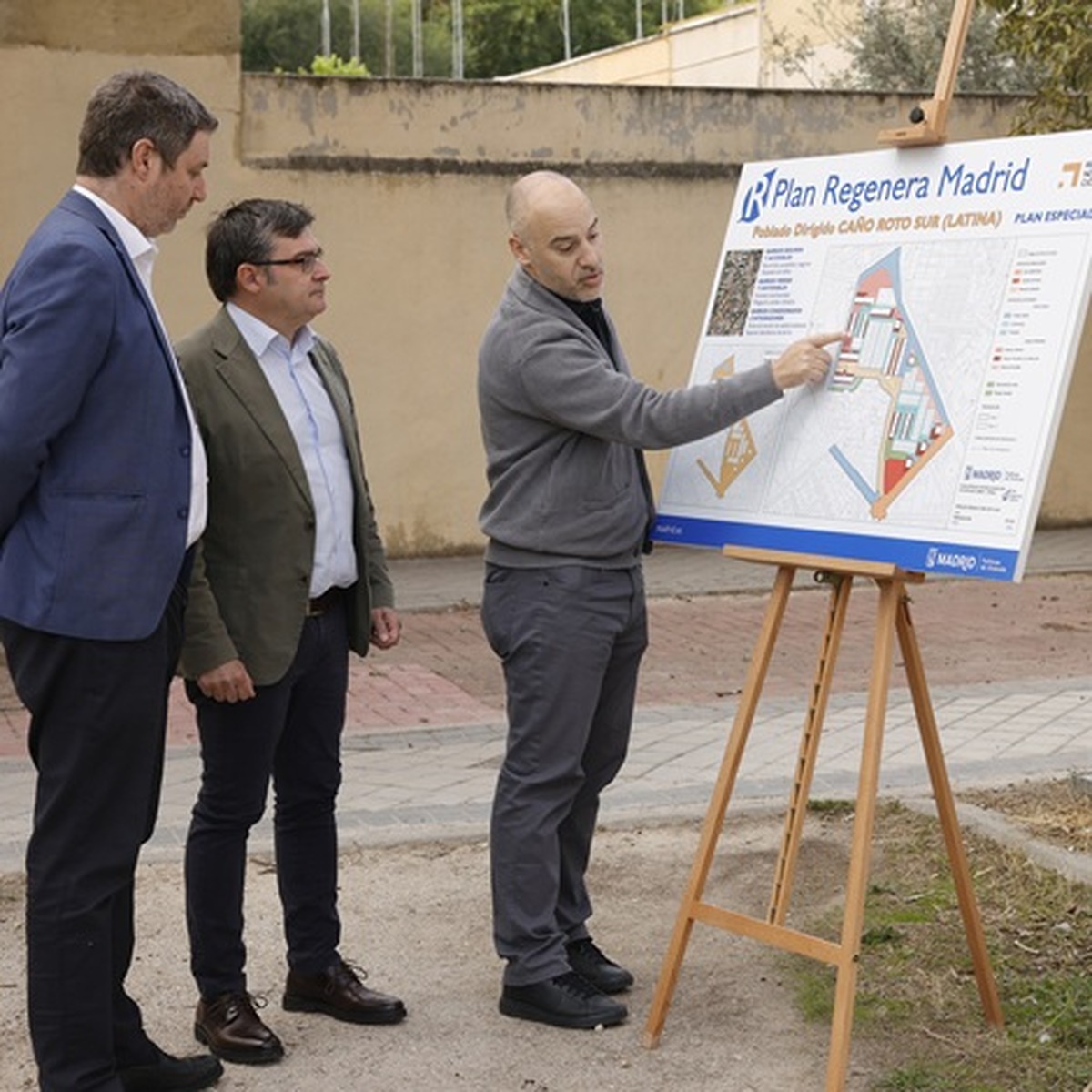
Álvaro González, the delegate for Housing Policies and president of the Municipal Housing and Land Company of Madrid (EMVS), visited the Caño Roto Sur settlement on Tuesday, accompanied by the councillor for Latina, Alberto González. This residential area is included in the Regenera Madrid Plan, which aims to establish the necessary conditions for future improvements to the local environment.
Constructed in the 1960s based on open-block urbanism principles, Caño Roto Sur features a layout where buildings are arranged around an extensive network of spaces between blocks, pedestrian pathways, green areas, and small interior squares. These spaces are integral to the residential structure of the neighbourhood and are frequently used by its residents.
Over time, these environments have required enhancements in accessibility, safety, and environmental quality. However, some of the land has undefined urban and registration statuses, complicating public intervention due to insufficient legal clarity despite its use as transit and communal areas.
The Special Regularisation Plan for Free Spaces (PEREL) in Caño Roto Sur, approved by the Government Board, aims to resolve these ambiguities and provide legal security for the land, facilitating its incorporation into the Municipal Land Heritage. This regularisation is a preliminary step towards studying and defining future regeneration actions.
The area covers 55,055 square metres, comprising 739 homes and a population of 1,778 residents. Of this area, over 35,000 square metres of free spaces are eligible for regularisation. The neighbourhood's layout revolves around a sequence of interconnected squares and narrow streets, necessitating improvements in pedestrian connectivity and communal spaces to create more accessible and comfortable pathways for residents.
Another significant aspect is safety, particularly regarding emergency service access to buildings. The configuration of the interior spaces requires careful consideration to ensure these access routes are compatible with pedestrian and community use.
The upcoming regeneration will also explore enhancements in landscaping, tree planting, and shrubbery, as well as the use of permeable materials and solutions that contribute to thermal comfort. Accessibility conditions for pathways will be analysed to facilitate movement for individuals of all ages and abilities.
Regularising the land will establish the necessary legal framework to address these issues systematically and define potential interventions in free spaces. The specific scope of the actions, budget, and timeline will be determined following the relevant studies and processing work.