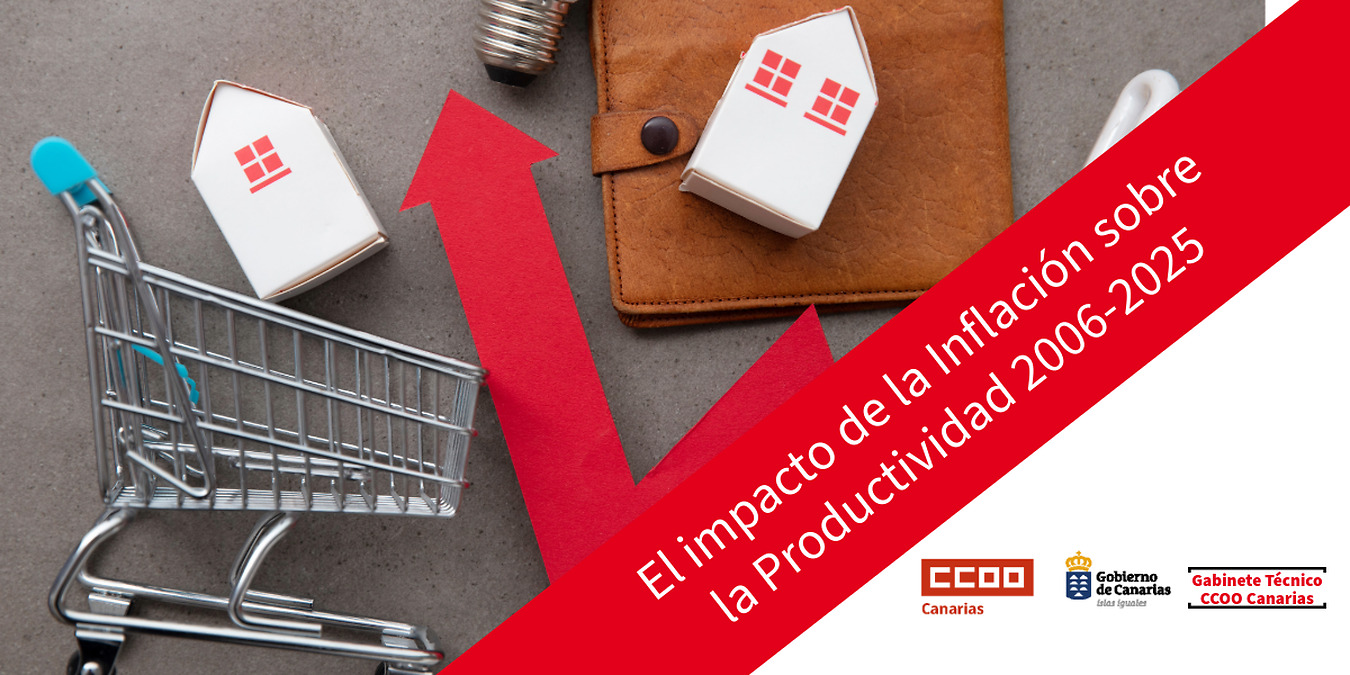
Recent research has highlighted the impact of inflation on productivity in the Canary Islands, revealing a stagnation in productivity levels compared to the national average. The analysis draws on annual data from the Consumer Price Index (CPI), the Active Population Survey, and the Regional Accounting of Spain from the National Statistics Institute (INE).
The study focuses on the Gross Domestic Product (GDP) per occupied person, adjusted for inflation, from 2006 to 2025. It indicates that since 2021, while national productivity has resumed a steady upward trajectory, returning to pre-COVID-19 levels, the Canary Islands have experienced stagnation, widening the productivity gap that has been evident since 2014.
Key findings
In 2006, the real productivity of a worker in the Canary Islands was 82.24% of the national average, but this figure is projected to drop to 79% by 2025. Over the same period, real productivity per occupied person in the Canary Islands has decreased by 1%, while the national average has increased by 3%. Despite this net decline, annual variations indicate that the Canary Islands can achieve real growth above the national average, with a positive trajectory in real GDP per occupied person expected from 2024, contrasting with a projected decline for the country as a whole.
Inflation's impact
The analysis shows that inflation has significantly distorted productivity indicators. The increase in GDP per occupied person at current prices since 2021 has largely been driven by rising prices rather than an actual improvement in operational efficiency or value added per job created. The Canary Islands' economy is heavily reliant on low-value-added services, making it vulnerable to inflationary pressures that dilute real productivity.
Furthermore, the decline in productivity cannot solely be attributed to worker attitudes or absenteeism, as high inflation also plays a critical role. The findings challenge the common narrative that low productivity in the Canary Islands is due to worker behaviour, indicating instead that it stems from structural issues related to a production model focused on lower-value activities, insufficient investment, and a lack of innovation.
Call for change
Between 2006 and 2025, the decline in real productivity per occupied person in the Canary Islands stands in stark contrast to the 3% growth seen nationally. Alarmingly, the recovery of real productivity observed in Spain since 2021 has not mirrored the situation in the Canary Islands. This suggests that the working population cannot be held accountable for a productivity gap that largely reflects the limitations of the economic model.
Trade union CCOO Canarias argues that these results underscore the need to shift the focus of the productivity debate. The emphasis should not be on working harder or intensifying labour rhythms, but rather on improving investment, fostering innovation, enhancing work organisation, and creating higher-quality jobs with greater value added. This aligns with the confederal document 'A trade union perspective on productivity (2025)', which identifies investment, technology, training, and robust public infrastructure as key drivers of productivity.
Additionally, analyses from CCOO Canarias regarding wage evolution highlight the challenges of translating economic growth into real improvements in workers' incomes. Consequently, CCOO continues to advocate for a transformation of the Canary Islands' production model, aiming to close the productivity gap with Spain through collective bargaining, better wages, training, and business investment, while ensuring that productivity gains are distributed more equitably among those who contribute to wealth generation.