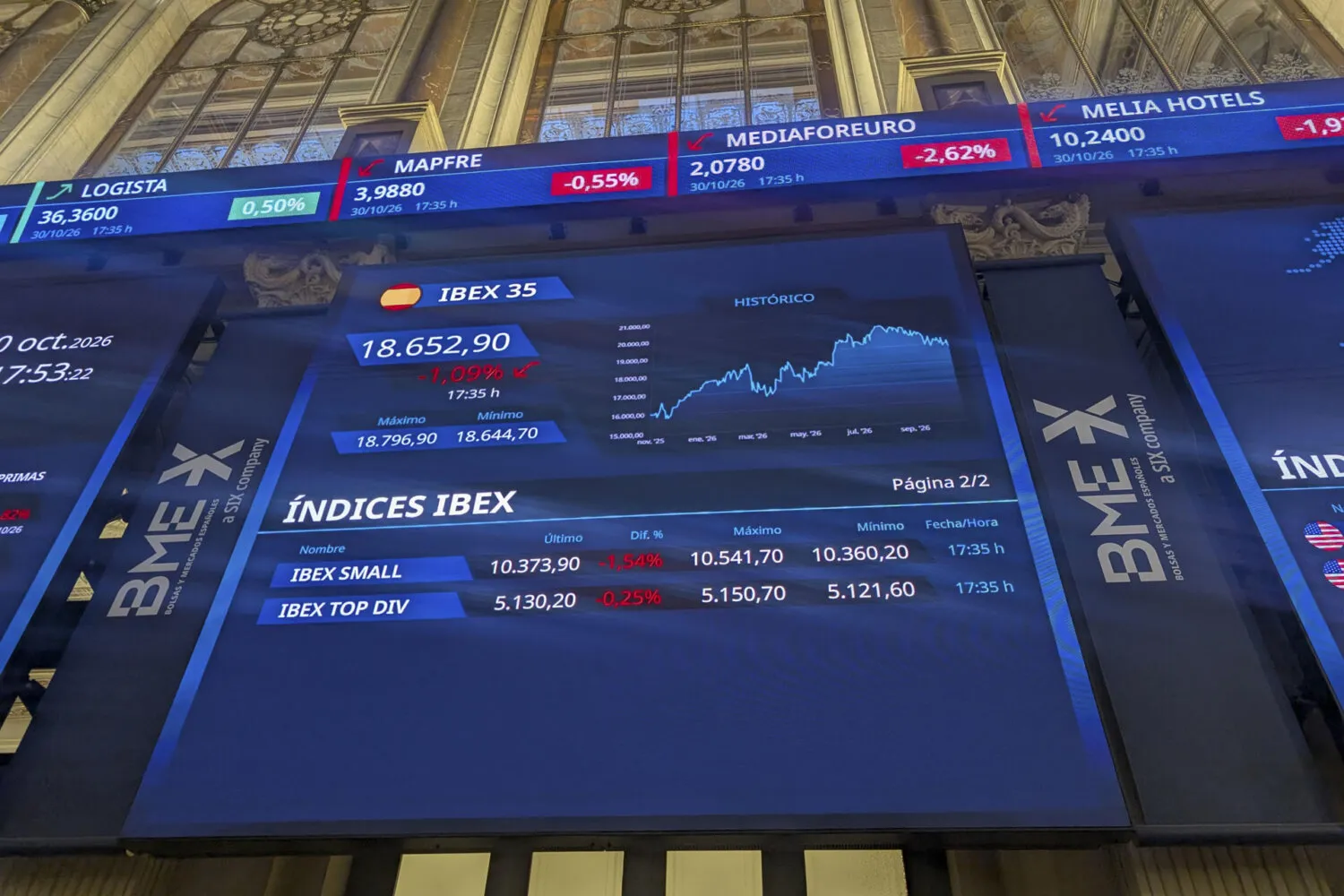
The Spanish stock market experienced a decline of 1.09% on 30 October, closing below the 18,700-point mark, primarily driven by falling banking stocks and a downturn on Wall Street, particularly in the technology sector. The benchmark index lost 204.7 points, finishing at 18,652.9 points, returning to levels not seen since early June.
Over the week, the market has decreased by 1.77%, and in October alone, it has dropped by 3.98%, marking the second-largest monthly decline of the year after March. However, the index is still up by 7.77% year-to-date.
European markets reflect similar trends
European stock markets also saw losses, with the euro trading at 1.156 dollars, down by 0.2%. Milan fell by 1%, Frankfurt by 0.85%, and Paris by 0.01%, while London managed a slight gain of 0.07%.
The trading day was heavily influenced by the previous day's drop on Wall Street, where major tech companies like Alphabet, Intel, and Amazon reported losses. By the end of the trading session, the Nasdaq Composite index had fallen by 2.65%, the S&P 500 by 1.61%, and the Dow Jones Industrial Average by 0.72%.
Rising oil and gas prices
Simultaneously, oil prices continued to rise, exacerbated by tensions in the Strait of Hormuz and incidents involving oil tankers. The price of Brent crude increased by 2.42%, reaching 117.66 dollars per barrel, while West Texas Intermediate rose by 2.32%, settling at 104.37 dollars. Natural gas prices in the Dutch market also surged by 5.3%, reaching 103.82 euros per megawatt-hour, a price not seen since late December 2022.
Inflation trends across Europe
Preliminary inflation figures for October from several European countries indicate ongoing price increases, which are likely to lead to further interest rate hikes. In France, inflation rose from 3.1% to 3.4%, while in Italy it jumped from 4.2% to 5.4%. In Spain, inflation remained steady at 4.9%, and in Germany, it decreased from 3.1% to 2.8%.
While the French economy contracted by 0.1% year-on-year in the first nine months of the year, Spain's economy grew by 2.7%, and Germany's by 1.2%.
Major stock movements
Among the major stocks, Banco Santander fell by 3.75%, and BBVA dropped by 3.7%, marking the third and fourth largest declines on the IBEX 35 index. Inditex, known for its Zara brand, saw a slight decrease of 0.25%. On the other hand, Repsol recorded the largest gain on the IBEX, rising by 4.49%, followed by Telefónica at 1.44% and Iberdrola at 0.36%.
Acerinox, after releasing its financial results, suffered the largest drop on the index, plummeting by 5.47%, while Solaria fell by 5.1%. Other notable declines included Indra, which dropped by 2.32%. Grifols, Puig, and Rovi also saw gains, with increases of 2.81%, 1.9%, and 1.62%, respectively.
The yield on Spanish ten-year bonds fell by nearly two basis points to 3.944%, while the risk premium against Germany finished at 62.3 basis points. Gold prices also saw a decline, dropping 3.12% to 3,819 dollars per troy ounce, a level last seen in October 2025. Bitcoin, which had fallen by 3% earlier, recovered slightly, decreasing by 2.09% to 77,149 dollars following reports of a potential theft of 6.3 billion dollars in cryptocurrencies from the Binance platform.