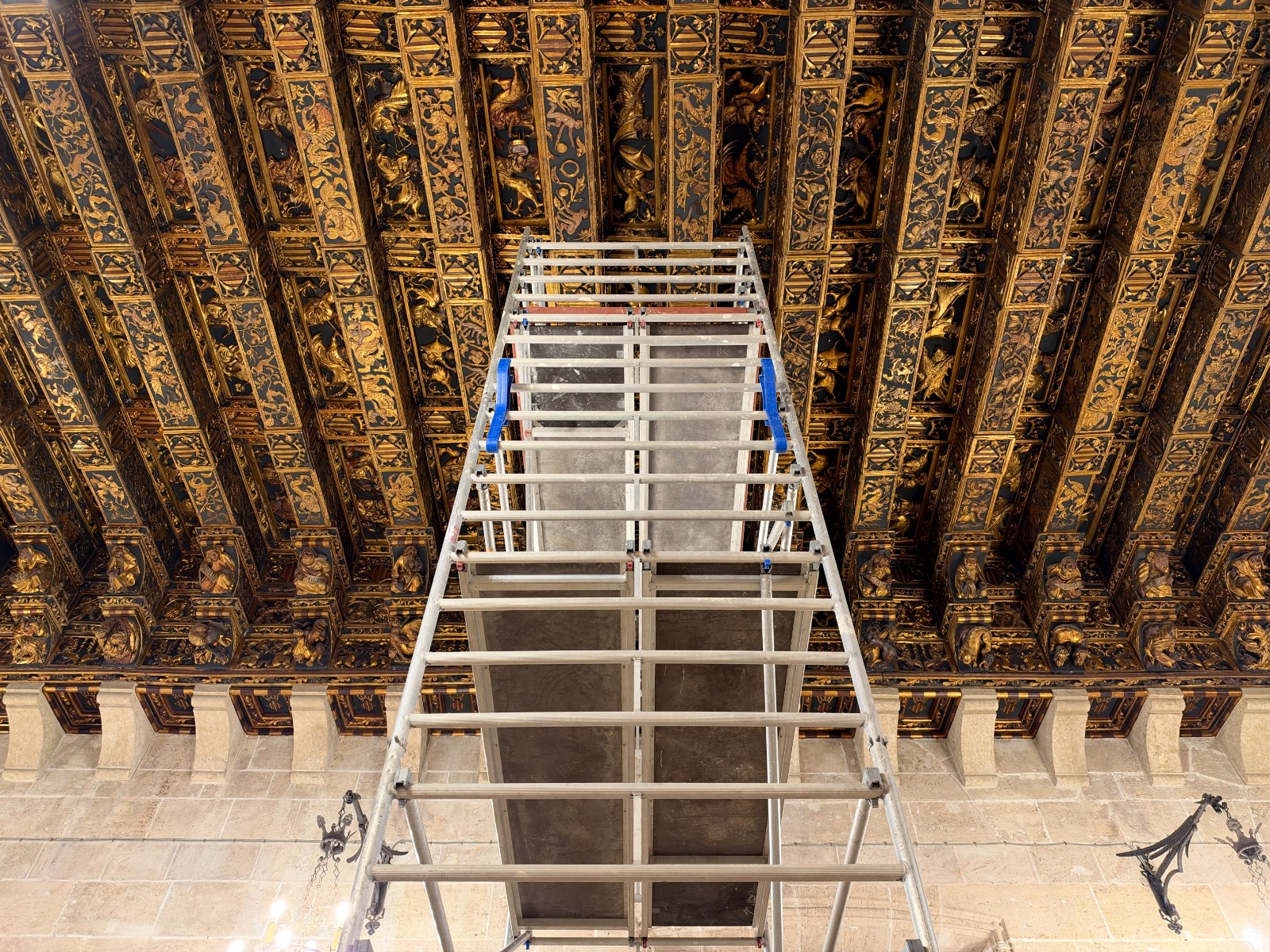
The València council has initiated preliminary restoration work on the wooden ceiling of the Golden Hall located within the Lonja de los Mercaderes, a UNESCO World Heritage site since December 1996. This year marks the 30th anniversary of its designation as a cultural landmark.
On 21 September, the Cultural Action, Heritage and Cultural Resources Delegation awarded the contract for structural assessments and preventive treatments against wood-eating pests to Noema Restauradores S.L. for €36,070.10, including VAT. The restoration is expected to take three months, during which the Golden Hall will be closed to the public.
“The wooden ceiling is undoubtedly one of the great jewels of Valencia's artistic heritage,” said José Luis Moreno, the councillor responsible for the area. “Before undertaking its recovery, it is essential to conduct a precise diagnosis of its current state, always respecting the original materials and the extraordinary value of the ensemble.”
Comprehensive conservation study
The restoration, authorised on 31 July by the Directorate General of Cultural Heritage, aims to conduct a thorough assessment of the current conservation status of the ceiling. This will involve intervention on two beams and the lifting of one square metre of the upper floor's floating floor to access the internal structure for analysis.
The ceiling, a masterpiece of medieval art, is currently obscured by layers of dirt accumulated over time, atmospheric pollution, and lack of maintenance, significantly affecting its preservation and visibility. The restoration will include cleaning the accumulated dirt while preserving the original surface layers.
Historical significance of the wooden ceiling
The wooden ceiling originally adorned the Golden Hall of the former City Hall, which was a symbol of the municipal government's authority. Commissioned in 1418, it was designed to showcase the city's splendour during its Golden Age. Crafted by Joan del Poyo and other prominent artists, the ceiling consists of 670 pieces across 19 wooden beams, featuring intricate carvings, paintings, and gilding that depict the city’s coat of arms, military motifs, and fantastical figures.
After a fire in 1853 damaged the old City Hall, the ceiling was dismantled and stored until it was relocated to the Consulado del Mar in 1920, where it was reassembled and completed in 1923.
Artistic programme of the ceiling
The ceiling's elaborate design features a variety of images, including dignified prophets and hybrid creatures, symbolising good and bad governance. The artistic techniques and narratives woven into the ceiling reflect the cultural richness of Valencia during its Golden Age.
“The expressiveness of the faces, the movement of the figures, and the quality of the painting and gilding make this series an exceptional ensemble,” noted architect Arturo Zaragozá.